Most lead types ask you to do a lot of work before a real conversation starts.
You buy the data, you dial, you leave voicemails, you follow up three times. By the time you reach someone, they've forgotten they filled out a form. Or they're talking to four other agents.
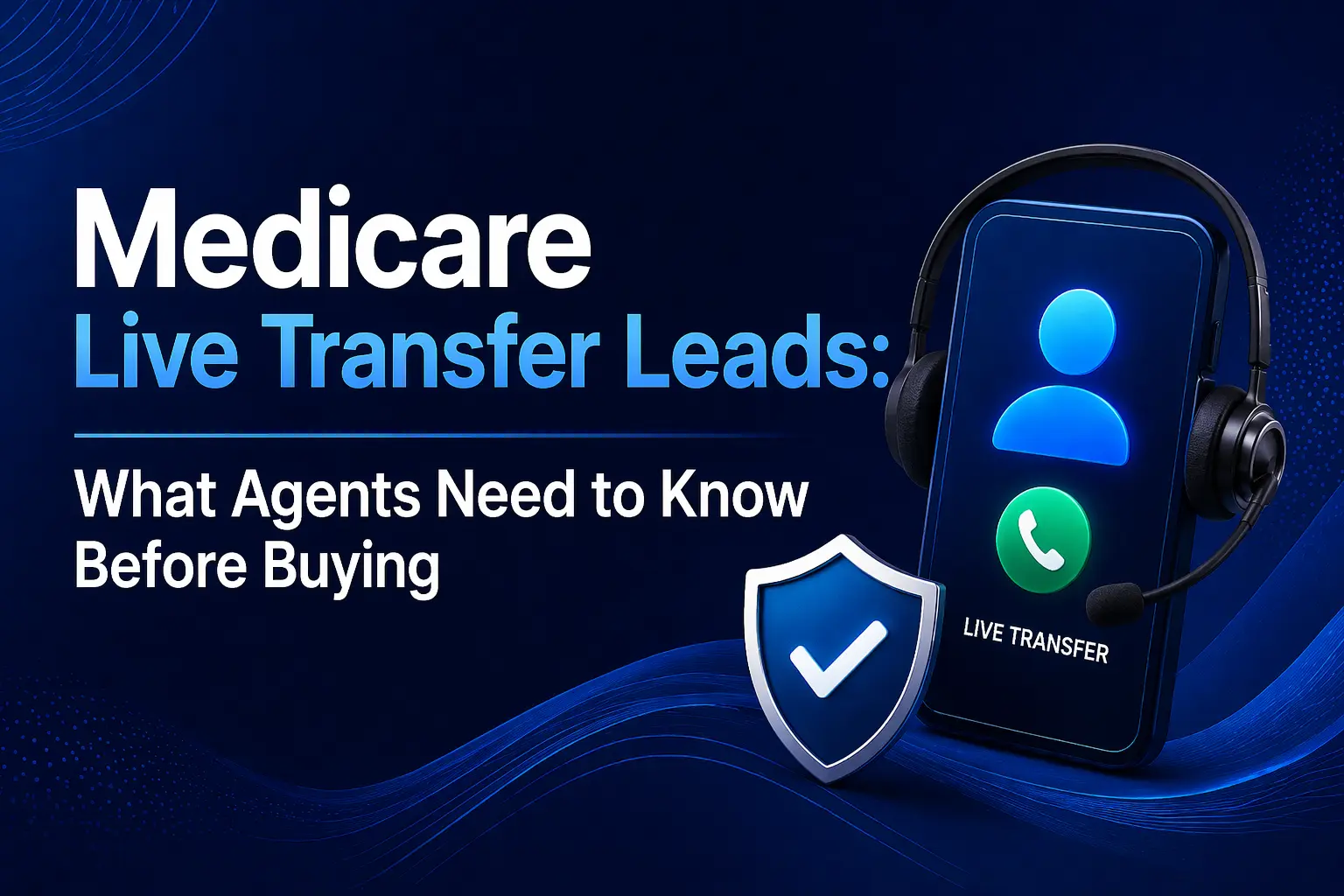
Medicare live transfer leads work differently.
The prospect is already on the phone, already engaged, already asking about coverage. Your job starts at hello, not two weeks of chase calls before it.
But the quality gap between providers is significant.
A poorly qualified transfer is just a cold call with extra steps. The right provider knows when and how to change the conversation entirely.
Connect with high-intent callers through Senior Center Agents.
Where Can Agents Buy Compliant Medicare Live Transfer Leads in 2026?
Agents should buy Medicare live transfer leads from providers that capture consent before the call, pre-qualify for Medicare eligibility (65+ or disability), and route calls in real time. Anything less turns a live transfer into an expensive cold call.
The market has grown, which means more options and more variance in quality. Meanwhile, the compliance environment has gotten more complicated—not less. Here's what to look for before you commit to any provider.
Compliance documentation
Ask directly: how is consent captured, and can the provider produce that documentation? TCPA violations ran at a steady pace through 2025—2,588 lawsuits filed in that year alone, essentially flat from the prior year. That number is expected to climb in 2026 as new state laws take effect. If a vendor can't explain their consent process clearly, that's your answer.
Lead qualification standards
What happens before the call reaches you? A qualified transfer should confirm Medicare eligibility (age 65+ or qualifying disability), verify the prospect is actively looking for coverage, and screen out anyone confused about why they're on the call. Transfers that skip this step inflate volume and destroy close rates.
Exclusivity
Is the prospect being transferred to one agent, or to whoever picks up first across a pool of buyers? Shared transfers reduce cost but also reduce your odds. Know what you're buying.
Call source transparency
Where are these calls coming from? Google Ads, Facebook, TV, direct mail? Each source produces a different type of caller. Providers who can tell you the source—and back it with performance data—are the ones worth working with.
Senior Center Agents connects agents with inbound callers in the senior market, with routing built around agent availability rather than whoever happens to be free.
What Are the Best Medicare Live Transfer Lead Providers for Closers?
The best Medicare providers for closers deliver pre-qualified callers who expect to speak to an agent immediately, route calls to a single agent (not a shared pool), and maintain consistent connection quality without dropped or misrouted transfers.
Closers have a specific problem.
They need volume and quality at the same time. Too much of one usually kills the other. When evaluating providers, here's the framework that matters:
Closers face a unique challenge. They need high volume without sacrificing quality.
When evaluating providers in 2026, use this five-point framework to separate top-tier partners from low-quality vendors:
Lead Quality
Are transfers verified before they reach you? A provider worth using confirms Medicare eligibility and intent before the handoff. With millions of Americans now enrolled in Medicare Advantage plans, the pool of prospects is massive. But the value lies in pre-screening for specific needs.
Exclusivity
The best transfers are routed to one agent only. Semi-exclusive setups where multiple agents compete for the same caller typically lead to lower conversion rates and a poor consumer experience.
Compliance
TCPA exposure is active and carries heavy liability. Sales teams rate inbound leads as higher quality than outbound, largely because inbound consent is cleaner and more documented by design. Ensure your provider can produce one-to-one consent records for every call.
Pricing Transparency
You should know the exact cost per transfer, the specific refund policy for unqualified calls, and how pricing scales with volume. Legitimate providers operate with "open books" regarding their communications activities and materials and how they adhere to CMS standards.
Routing Reliability
If a transfer hits a busy signal, that lead is dead. Routing systems must match calls to available agents in real time. Systems that utilize one-to-one consent logic ensure that the prospect is connected to the specific licensed agent they are expected to speak with, reducing friction and drop-offs.
Senior Center Agents is built specifically for the senior market, with call routing designed around agent availability. The focus is on connecting callers to agents who are ready, not just whoever's in the system.
How Do Medicare Live Transfer Lead Pricing Structures Work?
Medicare live transfer pricing is based on how likely the call is to convert. Providers charge more for longer connected calls, verified eligibility, and exclusive routing because those factors reduce wasted conversations.
Live transfer leads cost more than form leads. That's the right trade-off, but understanding why helps you evaluate whether a price is justified.
What Factors Influence Live Transfer Lead Pricing?
Pricing increases when calls are pre-screened for eligibility and intent, routed exclusively to one agent, and held to minimum connection times (e.g., 60–90 seconds), since each step improves conversion probability.
Here are the details:
Call duration and connection quality. Most providers charge for transfers only after a minimum connected time (often 60–90 seconds). Calls that drop before that threshold typically qualify for a replacement or credit. Confirm this before buying.
Qualification level. A transfer that's been pre-screened for eligibility, coverage intent, and geographic fit costs more than a raw inbound call. The additional qualification reduces wasted conversations which is worth the price difference for most closers.
Exclusivity. Exclusive transfers (one agent, one caller) carry a premium. The math usually works out because one exclusive transfer at a higher price point outperforms two shared transfers at a lower one, assuming your close process is solid.
Volume commitments. Some providers offer lower per-transfer pricing at higher volumes. This makes sense once you've validated a provider's quality, not before.
What Is the Typical Cost Range for Live Transfers?
Live transfer leads cost significantly more than form leads because you’re paying for a real-time, pre-qualified conversation where the prospect is already on the phone and expecting help.
Pricing varies by market, qualification level, and exclusivity, but expect to pay significantly more per transfer than per form lead.
The premium reflects intent.
A caller who's already on the phone asking about Medicare coverage is worth considerably more than someone who filled out a form three days ago and barely remembers doing it.
After five months of consistent inbound lead generation, cost per lead typically drops 80% compared to outbound. The economics of inbound compounds over time in ways that cold outreach can't replicate.
Are Medicare Live Transfer Leads Exclusive and High-Intent?
Yes, high-quality Medicare live transfer leads are both exclusive and high-intent when the prospect has been pre-qualified, has expressed interest, and is connected to a single agent.
Intent is what makes live transfers worth the price. But not every transfer delivers that.
Exclusive vs. semi-exclusive
Exclusive means one agent receives the transfer. The prospect isn't simultaneously being connected to competitors. Semi-exclusive arrangements exist, but they dilute your advantage on every call.
The qualification process matters
High-intent doesn't happen automatically. It requires a qualification layer before the transfer—confirming the prospect is Medicare-eligible, interested in coverage now, and expecting to speak with an agent. Transfers that skip this produce calls that feel cold despite being "live."
Intent signals to look for
The strongest transfers come from prospects who initiated contact (inbound call, form fill, click-to-call ad), confirmed their eligibility during pre-screening, and weren't transferred after a long hold. Every step between the prospect's original action and your phone ringing costs intent.
One specific area driving higher-intent calls right now: special needs plans.
SNPs now account for 23% of all Medicare Advantage enrollment. 83% of MA enrollment growth in the past year came from these plans.
Callers with chronic conditions or dual-eligibility are actively looking for the right fit. That's a high-intent demographic by definition.
How Can Agents Increase Close Rates on Medicare Live Transfer Leads?
Close rates improve when agents answer within seconds, use pre-call qualification data to personalize the opening, and guide the conversation through needs assessment before discussing plans.
The transfer is the setup. The close is still on you. Here are the few things that move the needle and entail:
Answer immediately
This sounds obvious, but it's the single biggest factor. A live transfer that hits voicemail is a dead lead. If you're not in a position to take calls, your routing system should be sending them somewhere else—not to a phone that rings out.
More on that: Why Speed to Answer Matters More Than Call Volume
Lead with what they already told you
Good providers pass along qualification notes with the transfer—what the prospect said they're looking for, their current coverage, location. Use it.
Starting the call with "I see you're looking at Medicare Advantage options in [county]" lands differently than "so what can I help you with today?"
Build trust quickly
Seniors want an advisor, not a salesperson. The first 90 seconds should establish that you understand their situation, not pitch a plan.
Ask about their current doctors, their medications, what's frustrating them about their current coverage.
Control the conversation without rushing it
Live transfers create urgency, but pushing too fast signals that you're selling rather than helping.
Move through eligibility confirmation, needs assessment, and plan comparison in order. Skipping steps to close faster usually costs you the close entirely.
Know your plans cold
An agent who has to put a caller on hold to look something up loses the moment.
If you're handling complex cases (i.e. a senior managing multiple chronic conditions and asking whether a specific specialist stays in-network), you need to respond with confidence, not guesswork. That preparation is what separates closers from order-takers.
Senior Center Agents routes high-intent callers to agents who are available and ready. The infrastructure is built for closers.
How to Route Medicare Live Transfer Calls to Multiple Agents Efficiently?
Efficient routing requires matching calls to agents who are actively available (not just logged in) using real-time availability rules and immediate fallback routing if a call isn’t answered.
Simply put, routing is where a lot of teams lose transfers they've already paid for.
What Systems Are Needed for Call Routing?
Call distribution tools
At minimum, you need a system that can ring available agents in real time and handle fallback routing when no one picks up. Basic IVR setups aren't enough for live transfers. You need availability-based routing that knows who's ready before the call connects.
Read more: Availability-Based Routing: A Smarter Way to Balance Coverage
CRM integration
Transfer data (caller information, qualification notes, source) should flow directly into your CRM at the moment of connection. Agents shouldn't be manually logging anything during the call.
Performance dashboards
Which agents are converting? Which transfer sources produce the best results? Realtime visibility into those metrics lets you adjust routing rules, reassign call volume, and coach agents on what's working.
More on that: How Realtime Visibility Improves Coaching and Performance
How to Avoid Missed or Dropped Calls?
Availability management. Agents should only be in the queue when they're genuinely ready to take a call. An agent who's mid-enrollment, at lunch, or on another call receiving a transfer creates a bad experience for the prospect.
Backup routing. Every routing setup needs a fallback. If the primary agent doesn't answer within a set number of rings, the call should route to a backup agent.
Are Medicare Live Transfer Leads TCPA Compliant?
Medicare live transfer leads are TCPA compliant only when prior express written consent is properly obtained and documented before the transfer occurs.
Compliance is the part agents often assume someone else has handled. That assumption creates liability.
Consent requirements
TCPA requires prior express written consent before a prospect can be contacted using an automated dialer.
For live transfers, that consent must be obtained before the transfer is initiated, not after. This hasn't gotten simpler. The FCC's one-to-one consent rule was vacated by the Eleventh Circuit in January 2025 before it took effect.
But the CMS version of that rule did take effect in October 2024 and still applies to Medicare marketing. Third-party marketing organizations must obtain written consent before sharing any personal beneficiary data, with each recipient entity listed by name.
State-level exposure is growing
Federal rollback means the risk has shifted to the states.
Oregon's HB 3865 took effect January 2026, capping daily contact attempts at three per consumer and restricting hours to 8 AM–8 PM.
Texas SB 140 (effective September 2025) expanded TCPA-style protections to include texts, with a private right of action up to $5,000 per violation.
Florida's FTSA has long carried $500–$1,500 per violation with a private right of action that's produced significant class action activity.
Oregon violations can reach $5,000 per violation, while New Jersey goes up to $10,000 for a first offense and $20,000 for subsequent ones.
Opt-in standards
The consent language matters. A generic "I agree to be contacted" checkbox isn't sufficient.
The type of contact, the purpose, and the entity making contact all must be named. Weak opt-in language is a legal vulnerability even if the prospect clicked something.
Vendor responsibility
TCPA violations can follow the agent, not just the vendor. If a provider is generating transfers with insufficient consent documentation and those calls reach your phone, you can be exposed.
Ask for the consent flow. Get it in writing. For live transfers specifically, CMS regulations allow verbal consent. But it must be recorded and the prospect must explicitly name the TPMO before the transfer completes.
Senior Center Agents is built around compliant call sourcing. Review the privacy policy and terms and conditions for specifics.
What Makes a High-Quality Medicare Live Transfer Lead?
A high-quality Medicare live transfer lead includes verified intent, confirmed eligibility, proper timing, and clear consent before the call is connected.
Not all transfers are created equal. Here's what a genuinely high-quality transfer looks like:
Verified intent
The prospect expressed interest in Medicare coverage through a specific action—a search ad click, a form fill, a response to direct mail—not a sweepstakes entry or an ambiguous opt-in.
Eligibility confirmation
Age and Medicare eligibility should be confirmed before the transfer, not discovered during the call. Finding out mid-conversation that a prospect is 58 with no qualifying disability wastes everyone's time.
Correct timing
Transfers during open enrollment, special enrollment periods, or when a prospect is turning 65 convert better. Timing-aware sourcing matters. With 12,000 Americans turning 65 every day—roughly 4 million per year—there's a consistent stream of new eligibles who need guidance outside of AEP windows entirely.
Proper qualification
The prospect should know they're about to speak with a licensed Medicare agent about their coverage options. Under CMS regulations, if verbal consent is used for a live transfer, the prospect must explicitly name the organization they're being transferred to before the handoff completes.
Transfers where the prospect doesn't know what the call is about—or hasn't confirmed consent—are a compliance problem.
Are Medicare Live Transfer Leads Suitable for Small Agencies and Remote Teams?
Yes, they are, because they eliminate prospecting and deliver qualified callers directly, allowing small teams to focus on closing instead of dialing or managing follow-up sequences.
Live transfers are often associated with high-volume call centers.
But small agencies and remote teams can use them effectively. Sometimes more effectively, because every call gets more attention.
How Small Agencies Benefit from Live Transfers
Faster sales cycles. No prospecting, no cold outreach, no list management. A small agency with two or three strong closers can generate real revenue quickly when the calls are coming in already qualified.
Less administrative overhead. Form leads require follow-up sequences, re-engagement campaigns, and a lot of manual work to get someone on the phone. Live transfers skip all of that. Inbound leads cost 61% less per lead than outbound methods over time—a gap that matters especially when a small team has limited capacity to absorb wasted call time.
How Remote Teams Handle Live Transfer Leads
Call routing. Remote teams need routing systems that treat agent location as irrelevant. Calls should be distributed based on availability, not geography. An agent working from home should receive the same quality of transfer as one sitting in a physical office.
Centralized systems. CRM access, routing dashboards, and performance data all need to be accessible from anywhere. A remote team without visibility into call volume and agent availability is flying blind.
Senior Center Agents supports both small agencies and larger operations. Sign up as an agent to get started.
Live Transfer Leads vs. Standard Leads (Practical Comparison)
Factor | Live Transfer Leads | Standard Leads |
What you get | A caller already on the phone asking about Medicare | A name + phone number you have to chase |
Intent level | Prospect expects to speak to an agent now | Prospect may not remember opting in or is comparing options |
Cost per lead | Higher upfront ($$$–$$$$) | Lower upfront ($–$$$) |
Cost per acquisition (real) | Lower if you close efficiently (fewer wasted calls) | Often higher due to low contact and close rates |
Conversion behavior | You close during the call or shortly after | Requires multiple follow-ups before a conversation happens |
Time to first conversation | Immediate (seconds) | Hours to days (calls, voicemails, retries) |
Agent effort | Focused on closing | Mostly spent dialing, following up, and qualifying |
Failure mode | Poor provider = unqualified or misrouted calls | Most leads never convert or respond |
Best for | Closers who can handle real-time conversations | Agents with time to nurture and follow up repeatedly |
How to Scale Medicare Live Transfer Leads Without Losing Quality?
Scale by increasing volume only after you’ve validated close rates, tracked performance by source, and fixed routing or handling gaps. Otherwise, adding more calls to a broken system lowers ROI.
Scaling live transfers is about building the infrastructure to handle more without quality falling apart.
Work with reliable providers first
Validate one provider before diversifying. Know your cost per acquisition, your close rate, and your average call duration. That baseline tells you whether scaling makes sense—and what to protect when you add volume.
Monitor performance by source
Not all transfer sources perform the same, even within the same provider. Track results by campaign, geography, and time of day. The data usually reveals a top-performing segment worth doubling down on and a bottom tier worth cutting.
Optimize your call handling before scaling
Routing gaps, slow answer times, and undertrained agents get amplified at volume. Fix what's broken at the current scale before adding more calls to the system.
Scale gradually
A sudden spike in call volume strains routing, overwhelms agents, and produces rushed conversations. Increase volume in steps, monitor close rates at each level, and adjust before moving up again.
Stay ahead of compliance as you grow
Scaling into new states means inheriting new rules. Texas, Florida, Oregon, New Jersey—each carries distinct consent requirements, calling hour restrictions, and penalty structures. What's compliant in one state isn't necessarily compliant in another. Build compliance review into your scaling process, not as an afterthought.
Why Live Transfer Leads Outperform Every Other Medicare Lead Type
Success with Medicare live transfers depends entirely on managing a transition.
When a prospect is moved from a qualifying agent to you, they are at the peak of their intent. But they’re also at their most impatient.
If you treat a live transfer like a follow-up call, you’ve already lost the lead.
The agents who win in 2026 are those who treat the routing system as part of their sales team. This means having your CRM open, your plan-comparison tools loaded, and your headset on before the phone rings.
To win at the Medicare live transfer leads game, you have to be the expert they’ve been promised.
If you’re still chasing form leads and fighting the speed-to-lead race, you’re working harder for lower-intent data. Moving to live transfers shifts your energy from prospecting to consulting.
Senior Center Agents is built for agents who are ready to close. Inbound calls, realtime routing, and clean dashboards for teams of any size. Get started here or contact the team to learn more.
FAQ
What are the best medicare live transfer lead providers?
Choose providers offering documented TCPA compliance, exclusive transfers, and transparent pricing. Industry-specific platforms like Senior Center Agents typically deliver higher-qualified prospects than general lead vendors.
How much do medicare live transfer leads cost?
Pricing depends on qualification and exclusivity, commanding a premium over form leads due to higher intent. Consistent inbound sourcing can reduce lead costs by up to 80% over five months compared to outbound channels.
Are live transfer leads exclusive?
Exclusivity varies by provider; exclusive leads connect to one agent, while semi-exclusive leads are shared at a lower price point. Always verify exclusivity terms to ensure your close rates align with your investment.
Are medicare live transfer leads TCPA compliant?
Compliance is mandatory, but agents must verify the specific consent flow used for every transfer. While certain FCC rules shifted in 2025, CMS regulations still require documented written consent naming each receiving entity.
How can I increase close rates on live transfers?
Prioritize immediate answer times, reference provided qualification notes, and establish trust within the first 90 seconds. Maintaining deep product knowledge prevents the need for holds, which can break the momentum of a live call.
Can small agencies use live transfer leads?
Yes, small agencies often achieve higher ROI than large call centers because each high-intent lead receives more focused attention. Success depends on efficient routing and CRM integration rather than total team size.
How does call routing work for live transfers?
Routing systems distribute calls to available agents in real-time with automated fallback options for missed rings. Availability-based routing allows agents to toggle their status, ensuring callers are never transferred to a dormant line.