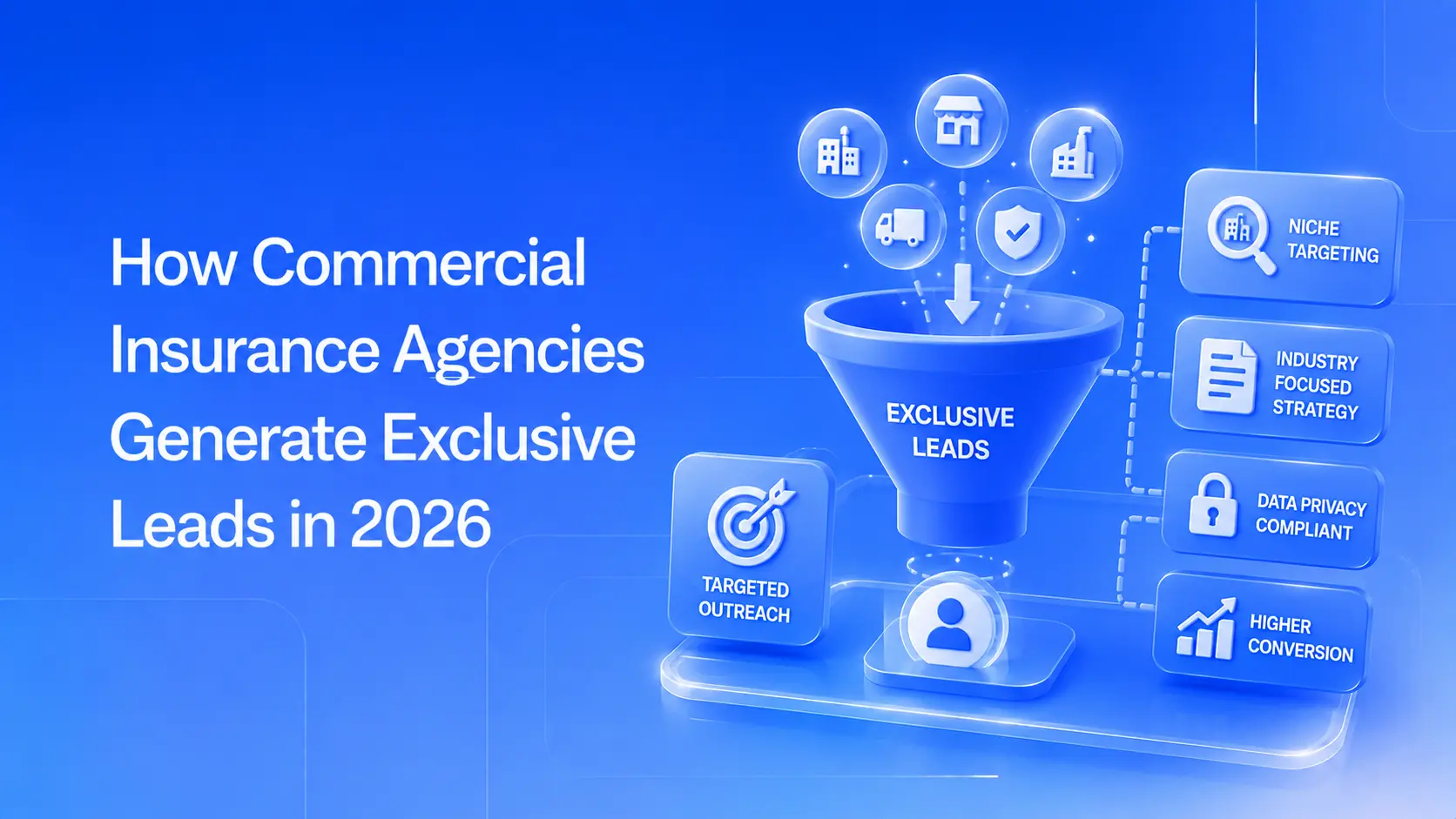
Commercial insurance is a different sales motion than personal lines. Sales cycles run longer, decision-makers are spread across operations and ownership, premium values per account are higher, and the industries with the most demand each have their own buying behavior. Commercial insurance lead generation has to account for all of that. The agencies that consistently fill their pipelines in 2026 are the ones building diversified lead engines that combine exclusive purchased leads with owned channels and disciplined follow-up.
This guide covers what commercial insurance lead generation involves, which channels produce the strongest results, how exclusive and shared models compare on cost per acquisition, and the playbook for verticals like commercial auto, where local agencies can compete effectively.
TLDR: Commercial insurance lead generation in 2026 is dominated by inbound digital channels, exclusive lead vendors, and referral partnerships. Industries like construction, transportation, healthcare, and technology generate the highest commercial demand. Exclusive commercial insurance leads convert at significantly higher rates than shared leads, and the highest-ROI agencies blend one paid channel for immediate flow with one organic channel for long-term cost reduction.
Senior Center Agents is built for independent agents who want qualified leads without the guesswork. Explore the platform to see how it fits your commercial book.
Key Takeaways
Commercial insurance lead generation is the B2B process of attracting and qualifying business owners and decision-makers with active coverage needs.
The three highest-converting lead sources for commercial agents in 2026 are exclusive purchased leads, Google PPC with commercial-intent targeting, and referral partnerships.
Shared commercial leads run lower per-lead cost but higher cost per acquired account because of contact competition.
Inbound digital strategies outperform cold outreach for commercial lines, particularly when paired with industry-specific content.
High-demand industries include construction, transportation, healthcare, hospitality, technology, retail, manufacturing, and real estate.
Exclusive commercial insurance leads convert at 2 to 4 times the rate of shared leads when paired with fast follow-up.
What Is Commercial Insurance Lead Generation and Why Does It Matter in 2026?
Commercial insurance lead generation is the structured process of attracting, identifying, and qualifying business owners and decision-makers who have an active need for commercial coverage. Business insurance lead generation differs from personal lines in four ways. Sales cycles are longer because purchasing decisions involve multiple stakeholders. Premium values per account are higher. Industry-specific risk profiles require targeted positioning. Buyer urgency varies based on renewal dates, business launches, or coverage gap events.
The 2026 conditions make lead generation more urgent. Insurtechs and direct-to-business carrier channels are absorbing prospects who would otherwise have shopped through an agent. Aggregator platforms have eroded traditional broker relationships in several verticals. Agencies that depend exclusively on referrals or cold outreach are watching pipeline quality decline.
A commercial insurance lead is qualified by business size, industry vertical, coverage need, and buying stage. Inbound generation pulls prospects through content, search, and referral. Outbound pushes outreach through ads, calling, and direct mail. Lead quality matters more than volume because acquisition cost per closed account drives margin.
Commercial Insurance Lead Generation Services for Brokers
Lead generation services range from legitimate high-performing vendors to data aggregators selling recycled lists at premium pricing. The five criteria every broker should evaluate:
Lead exclusivity model (one agency or several). Lead verification and intent scoring (genuine shopper or survey response). Industry and geography targeting (matches your licensing footprint). CRM integration and delivery format (real-time API or batch upload). Pricing transparency with a defined replacement policy.
The Difference Between Shared and Exclusive Commercial Insurance Leads
Shared leads are sold to three to five agencies simultaneously, which creates a race-to-contact dynamic. The first agent to call wins disproportionately often, and contact rates drop because the buyer experiences lead fatigue. Shared leads cost less per lead but typically produce a higher blended cost per acquisition.
Exclusive commercial insurance leads are sold to one agent only. Cost per lead is higher, but close rates are significantly higher because the prospect is not being worked by competitors. For most established commercial agencies, exclusive leads deliver a lower cost per acquired account over a full sales cycle.
Shared vs. Exclusive Commercial Insurance Leads
Factor | Shared Leads | Exclusive Leads |
Delivery Model | Sold to 3 to 5 agents simultaneously | Delivered to one agent only |
Average Cost Per Lead | Lower upfront cost | Higher upfront cost |
Average Conversion Rate | Low (high competition at contact) | Significantly higher |
Speed-to-Contact Pressure | Extreme (minutes matter) | Moderate |
Relationship Building | Low | High |
Blended Cost Per Acquisition | Often higher than exclusive | Often lower when quality is verified |
Best For | High-volume, price-sensitive agencies | Agencies focused on conversion quality |
Vendor Transparency | Varies widely | Higher accountability standard |
For most commercial agencies, blended cost per acquisition on exclusive leads is lower than on shared leads across a full sales cycle. The shared model only pencils out for agencies running very high dial volume with disciplined first-contact speed.
How to Get Qualified Commercial Insurance Leads Consistently
The single most common failure mode in commercial lead generation is single-channel dependency. The fix is a diversified strategy combining at least three channels with different speed and cost profiles.
Methods that produce qualified commercial leads in 2026:
Inbound SEO and content targeting commercial business owner queries delivers compounding lead flow over 6 to 12 months.
Google PPC and Local Services Ads targeting industry-specific terms produce immediate high-intent leads.
LinkedIn outreach and sponsored content targeting business owners, CFOs, and operations managers work for mid-market accounts.
Referral partnerships with commercial lenders, accountants, and business attorneys produce the highest-converting leads.
Exclusive lead vendor platforms fill the immediate pipeline while owned channels develop.
Chamber of commerce and business association networking creates relationship-driven leads.
Email nurture campaigns targeting cold prospects in high-demand industries warm leads over time.
Webinars and educational content convert at high rates because they pre-qualify the audience.
Appointment-setting services specializing in commercial lines accelerate pipeline development.
How to Outsource Commercial Insurance Appointment Setting Without Losing Control
A professional appointment setting service handles outbound calling against a targeted list, qualifies prospects against your criteria, and schedules appointments onto your calendar. The vetting checklist runs through industry specialization, script transparency, CRM handoff, performance guarantees, and TCPA and DNC compliance. It works best paired with an internal follow-up sequence owned by the producer.
What Industries Need Commercial Insurance the Most?
Industry targeting matters because not all commercial prospects carry the same premium value, conversion timeline, or retention profile. The industries that generate the most commercial demand in 2026:
Construction and general contractors with high liability exposure and bonding requirements
Transportation and trucking with commercial auto, cargo, and liability needs
Healthcare and medical offices requiring professional liability, workers' comp, and cyber
Restaurants and hospitality needing property, liquor liability, and business interruption insurance
Technology companies and SaaS businesses requiring cyber, E&O, and D&O coverage
Retail and e-commerce needing product liability, property, and BOP coverage
Manufacturing carrying equipment breakdown, product liability, and supply chain exposure
Real estate investors and property managers needing habitational, umbrella, and liability coverage
These industries should directly inform keyword targeting on paid campaigns and content strategy on inbound SEO. Generic commercial content rarely outperforms vertical-specific content because the buyer wants an agent who understands their industry.
Sign up as an agent at Senior Center Agents to connect with verified commercial insurance prospects through a platform built for independent producers.
B2B Commercial Insurance Lead Generation Strategies That Actually Convert
Generating leads and converting them are different problems. Most agencies invest in generation and underinvest in conversion, which is why average close rates on commercial lead vendor purchases run lower than they should.
The conversion framework that produces results: hit speed-to-contact within 5 minutes of lead delivery. Run a multi-touch follow-up sequence across phone, email, and text with 6 to 8 attempts before marking a lead lost. Lead with needs analysis and consultative positioning rather than a product pitch. Structure proposals around risk gap analysis, not just pricing comparison. Use CRM pipeline management to track every prospect through stage-specific follow-up.
Inbound Marketing Funnel for Commercial Insurance Producers
The inbound funnel runs across three stages. At awareness, prospects find you through SEO content, social ads, or referrals. At consideration, prospects engage with a lead magnet, webinar, or email nurture. Upon the decision, prospects accept a consultation, review a proposal, and bind coverage. Each stage requires different content, and most agencies underinvest in the consideration stage, which is where the highest-intent prospects make their decisions.
Commercial Insurance Lead Generation Channels Compared
Lead Generation Channel | Average Lead Cost | Lead Quality | Time to First Lead | Best Agency Size | Scalability |
Exclusive Lead Vendors | Medium to High | High | Immediate | Any size | High |
Google PPC / LSA | Medium | High intent | Days to set up | Mid to large | High with budget |
LinkedIn Outreach | Low to Medium | Medium to High | Weeks | Any size | Medium |
SEO / Content Marketing | Low long-term | High intent | 3 to 6 months | Any size | Very high |
Referral Partnerships | Low | Very High | Variable | Any size | Limited |
Cold Outreach / Calling | Very Low | Low to Medium | Immediate | Small agencies | Low |
Appointment Setting | Medium | Medium to High | 1 to 2 weeks setup | Mid to large | High |
Association Networking | Low | High (relationship) | Slow | Any size | Low |
Email Nurture | Very Low | Medium | Weeks | Any size | Medium |
The blended approach that works for most commercial agencies: one paid channel for immediate flow, one organic channel for long-term cost reduction, and one relationship channel for high-conversion referral volume. Three channels active simultaneously produce a consistent pipeline that single-channel agencies cannot match.
Buy High-Intent Commercial Property and Liability Leads: What to Know Before You Spend
Four questions every commercial agent should answer before buying leads. How does the vendor verify the prospect is actively shopping for coverage? What is the average age of the lead at delivery? What is the replacement policy for disconnected numbers or invalid contacts? Does the vendor specialize in commercial lines, or is it a personal lines platform retrofitted for commercial?
Commercial property leads usually come from a renewal trigger or coverage gap event. Liability leads often come from a new business launch, expansion, or regulatory requirement. The agencies that close best match lead source to their industry expertise.
The single most common reason agencies report poor ROI from lead vendors is buying leads without a follow-up system in place. Lead vendor spend without speed-to-contact discipline and a multi-touch sequence is wasted regardless of lead quality.
Best Platforms to Purchase Commercial Insurance Leads in 2026
The platform categories serving commercial insurance lead buyers fall into five buckets. Specialty commercial lead platforms focus on a vertical or coverage line, delivering higher quality at a higher cost. General insurance lead marketplaces sell across personal and commercial lines, run on shared models. Digital marketing agencies offer lead generation as a managed service.
In-house lead generation through owned digital assets requires upfront investment but produces the lowest long-term cost per acquisition. Agent network platforms combine lead generation with workflow tools, which is the category Senior Center Agents operate in.
The right fit depends on agency size, growth stage, and how much operational capacity you want to dedicate to lead generation versus outsourcing it.
Targeted Commercial Auto Insurance Leads for Local Agencies
Commercial auto is a strong entry point for agencies new to commercial lead generation. Prospect volume is high, industry targeting is clear (trucking, delivery, construction, service vehicles), and underwriting is straightforward compared to complex commercial liability. The local targeting tactics that work for commercial auto:
Geofenced Google display ads targeting business districts and industrial zones. LinkedIn targeting by job title (fleet manager, owner-operator, logistics director) and company size. Partnerships with commercial vehicle dealers and fleet maintenance shops. DOT registration data as a prospecting source, where state regulations permit its use.
All outreach must comply with TCPA regulations and state-specific solicitation rules, particularly for outbound calling and text messaging.
Create your free account at Senior Center Agents to start growing your commercial book with built-in lead generation tools.
Pay Per Lead Options for Commercial Insurance Agents
Pay per lead is the dominant pricing model for commercial insurance lead vendors. Cost ranges vary by exclusivity tier, industry vertical, geography, and intent level. Shared commercial leads run lower per lead at lower close rates. Mid-tier exclusive leads run mid-cost with stronger conversion. Premium verified exclusive leads with appointment setting sit at the top of the cost range and produce the lowest blended cost per acquisition.
Pay per lead makes sense when the agency wants variable-cost flow with no monthly commitment. Monthly retainer or managed service models make more sense when the agency wants a predictable budget. Cost per lead is a vanity metric without the cost per acquisition context. The question that matters is cost per closed account.
Commercial Insurance Lead Pricing and ROI by Model
Lead Model | Typical Cost Per Lead | Expected Conversion Rate | Est. Cost Per Acquisition | Best Use Case | ROI Timeline |
Shared Lead (3 to 5 agents) | Lowest | 2% to 5% | High | Volume testing | Immediate but low |
Exclusive Lead (verified) | Medium | 10% to 20% | Medium | Consistent pipeline | 30 to 90 days |
Exclusive + Appointment Set | Highest per lead | 25% to 40% | Lowest blended | High-value commercial | 60 to 120 days |
PPC Self-Generated | Varies by CPC | 10% to 25% | Medium to Low | Agencies with digital capability | 60 to 90 days |
Referral Partner Lead | Near zero | 40% to 60%+ | Very Low | Relationship-driven agencies | Long setup, best ROI |
SEO Inbound Lead | Low (time investment) | 15% to 30% | Very Low | Long-term pipeline | 6 to 12 months |
The highest-ROI strategy for most commercial agencies combines exclusive lead buying for immediate pipeline with SEO or referral development for long-term cost reduction. Single-channel dependency is the most common reason commercial agencies experience pipeline volatility.
How Digital Ads Help Generate Commercial Insurance Leads in 2026
Four primary digital channels carry commercial insurance lead generation in 2026.
Google Search Ads target high-intent commercial coverage queries like "commercial general liability quote" at a moderate cost per lead.
Google Local Services Ads work for geographically-focused agencies and deliver pre-qualified leads with built-in verification.
LinkedIn Sponsored Content and Message Ads target business owners and decision-makers by industry, company size, and job title at mid-to-high cost per lead.
Meta Ads run brand awareness and retargeting campaigns for prospects who visited the agency website.
Commercial insurance digital marketing requires more audience specificity than personal lines. Broad targeting wastes budget because conversion drops sharply when the audience does not match the agency's vertical expertise. Vertical-specific ad creative and landing pages are essential.
Are Exclusive Commercial Insurance Leads Worth the Higher Cost?
Yes, in most cases. Exclusivity delivers superior ROI on a cost-per-acquisition basis under three conditions. The agency has a fast follow-up system with speed-to-contact under 5 minutes. The agent has commercial lines expertise that differentiates the consultative approach. The agency targets a specific industry vertical where underwriting relationships and competitive rates exist.
Shared leads can make sense under two conditions. The agency is testing a new niche and wants to validate volume before committing to exclusive pricing. The agency operates at high volume with discipline on contact speed and nurture cadence.
For most agencies pursuing sustainable commercial growth, exclusive leads paired with a tight follow-up sequence outperform shared leads on every metric except headline cost per lead.
Talk to the Senior Center Agents team about your specific situation.
How Can Insurance Agencies Improve Commercial Lead Conversion Rates?
The conversion improvement framework runs through seven actions. Reduce response latency to under 5 minutes on new commercial leads. Use a multi-touch outreach sequence with 6 to 8 attempts across phone, email, and text. Lead with a consultative approach and open with risk gap analysis, not a quote request. Personalize outreach by industry to demonstrate expertise. Implement a CRM pipeline with stage-specific follow-up automation. Use social proof through case studies and industry references. Offer a no-obligation coverage review as the initial call to action.
Running all seven simultaneously can double commercial conversion rates within a quarter for agencies coming off a manual baseline.
Expert Viewpoint: Why Commercial Insurance Agencies That Build a Diversified Lead Engine in 2026 Will Win the Decade
Three observations from working with commercial agencies across the country. First, the consolidation of commercial insurance buying behavior around digital channels is permanent. Agencies that rely exclusively on referrals or cold outreach will watch pipeline quality decline over the next three to five years as buyer behavior continues shifting toward search-first and digital-first discovery.
Second, exclusivity in lead generation is not a luxury for commercial producers. It is the operational baseline that makes cost-effective scaling possible. Agencies still running on shared lead lists are effectively subsidizing competitors that have moved to exclusive sourcing.
Third, the agencies that will dominate commercial production in 2026 and beyond are not necessarily the largest. They are the most systematized. Lead generation strategy, CRM discipline, follow-up automation, and consultative selling compound over time into a competitive moat that scale alone cannot replicate.
Explore more agent resources on the Senior Center Agents blog for deeper coverage on lead generation, CRM workflows, and commercial lines strategy.
Make Commercial Insurance Lead Generation More Predictable With Senior Center Agents
The commercial agencies pulling ahead in 2026 stopped treating lead generation as a single-vendor purchase and started treating it as a managed system. Commercial insurance lead generation works better when it runs through a system built for qualified demand, fast follow-up, and day-to-day producer execution instead of disconnected vendors and manual handoffs.
Senior Center Agents helps independent brokers manage exclusive lead flow, routing, CRM activity, and workflow automation in one place, so commercial opportunities move through the pipeline with more visibility and less friction.
For agencies that want a steadier commercial book, better conversion discipline, and a cleaner way to support producer performance, that kind of structure creates a more reliable path to growth.
Explore how Senior Center Agents fits your commercial workflow. Create your free agent account and start building a more consistent commercial pipeline.
Frequently Asked Questions About Commercial Insurance Lead Generation
What is commercial insurance lead generation?
Commercial insurance lead generation is the structured process of identifying and attracting business owners with active commercial coverage needs. It serves brokers and agencies writing B2B insurance across industries like construction, transportation, healthcare, and technology. The process is more complex than personal lines because sales cycles are longer and decision-makers are spread across multiple stakeholders.
What are the best sources for commercial insurance leads in 2026?
The top sources are exclusive commercial lead vendors for immediate flow, Google PPC with commercial-intent targeting, referral partnerships with commercial lenders and accountants, and LinkedIn outreach to business decision-makers. Combining two or more channels produces a more consistent pipeline than any single source.
How much do commercial insurance leads cost?
Commercial insurance lead costs vary by exclusivity tier. Shared leads run the lowest cost per lead but the highest cost per acquisition. Exclusive leads run mid-range. Exclusive leads with appointment setting sit at the top and typically produce the lowest blended cost per acquisition.
Are exclusive commercial insurance leads worth it?
Yes, in most cases. Exclusivity delivers superior ROI when the agency has fast follow-up, commercial lines expertise, and a vertical-specific value proposition. Shared leads are viable for volume testing, but rarely the most cost-efficient path to growth at scale.
What is the best marketing strategy for commercial insurance leads?
The highest-performing strategy combines one immediate-flow channel, like exclusive leads or Google PPC, with one long-term organic channel, like SEO content or referral partnerships. Paid channels fund the current pipeline while organic channels reduce future cost per acquisition.
Which companies provide high-quality commercial insurance leads?
Quality varies by vendor. Key criteria include exclusivity model, real-time delivery, intent verification, and industry targeting. Evaluate vendors on a small test purchase before committing to volume. Agent network platforms combining lead generation with workflow tools offer an integrated alternative to standalone vendors.
How can small agencies compete for commercial insurance leads?
Small agencies compete by narrowing their target vertical rather than pursuing all commercial lines simultaneously. Specialization creates perceived expertise that converts at higher rates. Combined with an exclusive lead source and disciplined follow-up, small agencies can outperform larger generalists within a defined niche.