Insurance agents in 2026 are competing against direct-to-consumer carriers, insurtech platforms, and AI-augmented operations that have stripped manual work out of every customer-facing process. The agencies that still run on spreadsheets, manual quoting, and email-driven renewal reminders are not just less efficient. They are structurally disadvantaged on speed, customer experience, and unit economics.
Insurance automation software is the category that closes that gap, and the platforms that matter for independent agents in 2026 are the ones built for cloud deployment, native CRM integration, and AI-augmented workflows rather than the legacy RPA tools designed for enterprise carrier back offices.
This guide covers what insurance automation software does, where the highest-ROI use cases sit for independent agents, how AI changes the automation equation compared to rule-based RPA, and the specific evaluation criteria that should drive any buying decision. Cost frameworks, ROI math, and deployment model trade-offs are all here.
TLDR: Insurance automation software automates underwriting, quoting, claims intake, renewals, billing, and CRM workflows so agencies can scale without adding administrative headcount. AI-powered automation now handles document parsing, risk scoring, and customer communication on top of the rule-based RPA layer, and cloud-based platforms have made enterprise-grade automation accessible to solo agents and small agencies. Independent agents who automate core workflows in 2026 build a compounding operational advantage over those that delay.
If you want an agency platform built specifically for independent agents, you can explore Senior Center Agents to see how automation fits the daily workflow.
Key Takeaways
Insurance automation software handles policy issuance, claims intake, underwriting, renewals, billing, and CRM workflows that previously required manual effort.
The highest-impact processes to automate first are quoting, renewals, claims FNOL, and CRM follow-up sequences.
Conservative industry data shows 20 to 40 percent operational cost reduction in claims processing once automation is in place.
Both small agencies and large insurers benefit from automation, but cloud-based SaaS platforms have democratized access for independent agents.
AI and CRM integration are the 2026 differentiators that separate modern automation from legacy RPA tools.
Cloud-based deployment is now the default model for independent agents and small agencies.
What Is Insurance Automation Software and How Does It Work?
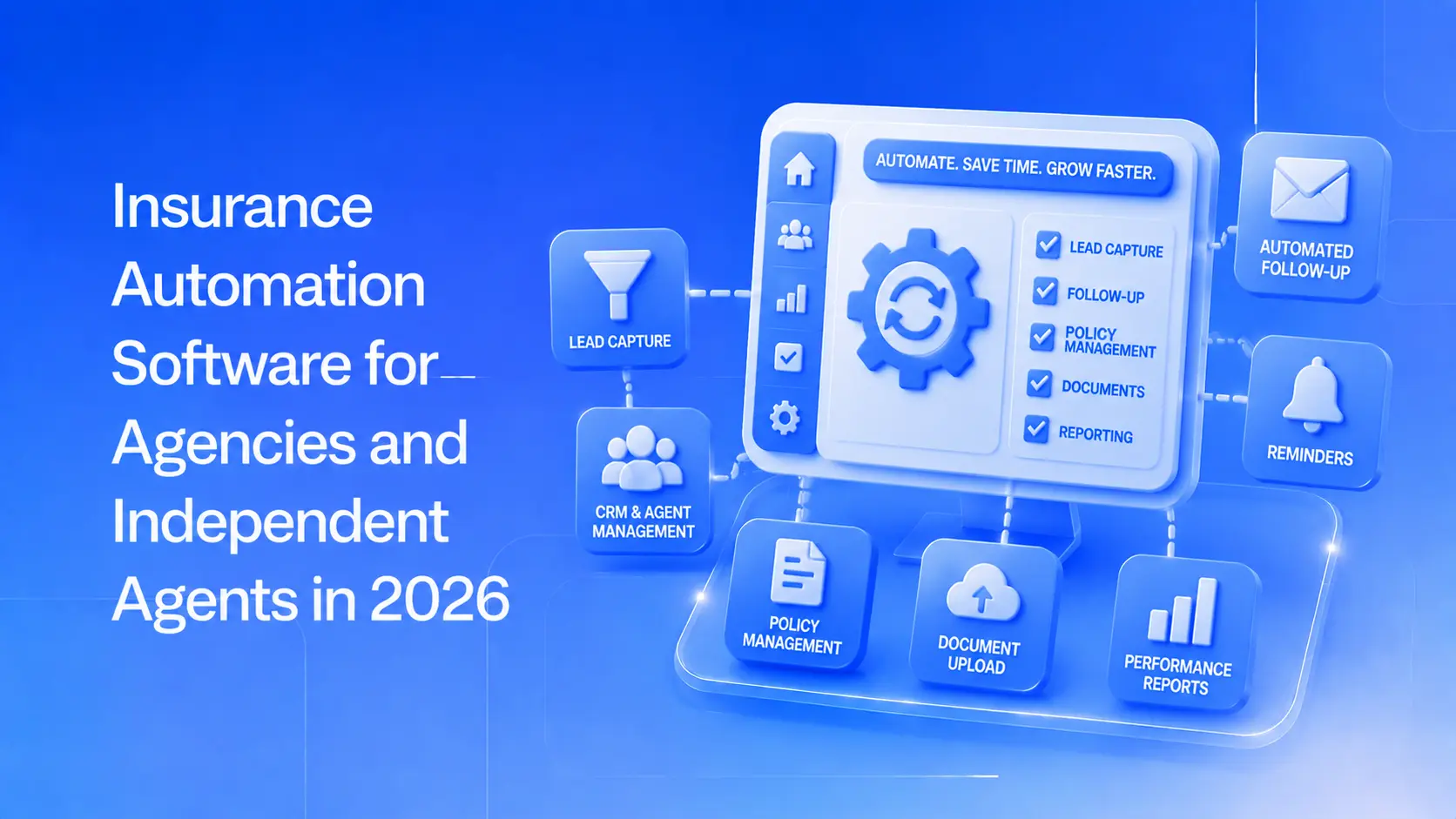
Insurance automation software is a category of platform that uses rule-based logic, AI, and API connectivity to handle repetitive insurance workflows without manual intervention. The core mechanics include trigger-based rules, AI-driven decision layers, CRM integration hooks, and direct connections to carrier systems. A new lead comes in, the platform routes it. A renewal date approaches, the platform fires the workflow. A claim arrives, the platform parses the documents and routes them.
The distinction between robotic process automation in insurance and AI-powered automation matters for buying decisions. RPA mimics manual clicks across screens and forms without understanding the context. AI insurance software learns from data, adapts when source systems change, and makes decisions that previously required a human reviewer. Modern platforms combine both layers.
The automation lifecycle inside any decent platform runs through five steps: data intake from forms or carrier feeds, workflow trigger based on configured rules, processing through the rules engine or AI layer, output to the next system or human reviewer, and an audit trail that captures every action for compliance.
Insurance Automation Software for Underwriting and Risk Assessment
Underwriting automation is one of the highest-ROI use cases because the manual version of the workflow is genuinely expensive. A traditional underwriter pulls applicant data from multiple sources, runs eligibility checks, scores risk against historical loss data, and routes the application to the next stage. Each step adds days to the quote cycle.
Automated underwriting compresses that into minutes. Data ingestion runs through APIs from third-party sources. Real-time risk scoring runs against configured rule sets. Exception flagging surfaces only the applications that actually need human judgment. The underwriter spends time on the cases that matter rather than on data entry.
How AI Changes the Underwriting Equation in 2026
The shift from rule-based underwriting to AI-augmented underwriting changes what the platform can handle. Machine learning models trained on historical underwriting data predict risk with more nuance than static rules. Computer vision interprets property images and inspection photos. Natural language processing reads medical records and treatment histories. The underwriter is still the decision-maker on complex cases, but the volume of cases the platform can pre-process before they hit a human queue has expanded dramatically.
Manual Underwriting vs. Automated Underwriting
Factor | Manual Underwriting | Automated Underwriting |
Processing Speed | Days to weeks | Minutes to hours |
Data Sources Used | Limited, manual pull | Multi-source, real-time API |
Error Rate | Higher, human-dependent | Lower, rule-based consistency |
Cost Per Application | High labor cost | Reduced marginal cost |
Scalability | Linear with headcount | Scales without added staff |
Compliance Tracking | Manual audit trail | Automated logging |
Human Oversight | Full review every application | Exception-based review only |
The table is a fair summary of where the categories stand, but the underwriter's role has not been eliminated. It has shifted. The automation handles 60 to 80 percent of routine applications. The human handles the 20 to 40 percent that actually require judgment.
What Insurance Processes Can Be Automated Right Now?
Almost every repetitive workflow inside an insurance agency can be automated to some degree in 2026. The list of mature use cases:
Policy issuance and binding with digital intake forms and integrated carrier submission
Renewal notifications with sequenced outreach at 90, 60, and 30 days before expiration
Claims intake and first notice of loss with automated triage and adjuster routing
Document collection and verification with OCR-based parsing and missing-document alerts
Premium billing and payment reconciliation with automated invoicing and matching
Compliance reporting and audit trails with continuous logging instead of monthly batch reports
Customer onboarding with e-signature workflows and digital welcome sequences
Cross-sell and upsell triggers through CRM-driven campaign automation
Agent licensing and appointment tracking with renewal alerts and state-by-state monitoring
Quote generation and comparison through integrated multi-carrier rating engines
Each of these workflows is either fully automatable or substantially automatable, depending on the platform. The agencies that get the most ROI are the ones that automate the workflows producers complain about most, since those are the workflows where manual time is highest.
Automated Insurance Workflows That Actually Improve Customer Experience
Most automation conversations focus on back-office efficiency, but the customer-facing wins are usually more important for retention. Faster claims resolution, proactive renewal outreach, real-time policy updates, and personalized communication triggers all change how the client experiences the agency relationship.
What Customers Expect From Digital Insurance Solutions in 2026
Customers expect text-based status updates on claims, the ability to e-sign documents from their phone, instant access to policy documents through a self-service portal, and proactive communication when something needs their attention rather than passive availability if they think to call. Insurance CRM automation is the connective tissue between back-office workflows and these customer touchpoints, and clients who experience the automated version of the relationship are demonstrably more likely to renew.
If you want to see how automation fits an independent agent's pipeline, you can sign up free at Senior Center Agents and start your first automated workflow.
Can Automation Software Reduce Insurance Operational Costs Significantly?
Yes, and the ROI math is well-documented across industry research. Conservative estimates from McKinsey and Deloitte put automation-driven cost reduction in claims processing at 20 to 40 percent. Renewal automation typically reduces processing time by 60 to 75 percent. CRM automation reduces lead response time from hours to seconds. The cost savings come from eliminating manual handoffs, reducing error rates, and freeing producer time for revenue-generating activity.
Software cost itself runs across a wide range. SaaS platforms targeted at independent agents start in the low monthly hundreds. Mid-market platforms for agencies run $500 to $2,000 per month. Enterprise licensing for carriers runs into six and seven figures annually. The pricing tier should match agency size and growth model rather than feature ambition.
How to Calculate ROI Before Buying an Insurance Automation Platform
A simple four-step framework. Identify the manual hours your agency spends on each automatable process per week. Assign an hourly cost based on the producer or staff salary for handling each task. Project automation saves 50 to 80 percent of those hours, depending on the workflow. Factor in the platform's monthly cost. If the projected savings exceed the platform cost within 12 months, the platform pays for itself. Most agencies hit that threshold within 6 to 9 months.
Insurance Automation Deployment Models
Deployment Model | Best For | Key Advantage | Key Limitation |
Cloud-Based SaaS | Small to mid-size agencies | Fast setup, low upfront cost | Ongoing subscription cost |
On-Premise | Large carriers with IT teams | Full data control | High maintenance burden |
Hybrid Cloud | Regional insurers | Flexibility, partial control | More complex integration |
Low-Code Platform | Agencies without dev resources | Non-technical configuration | Limited custom logic |
API-First / Headless | Tech-forward MGAs | Deep integration capability | Requires dev expertise |
For independent agents and small agencies, cloud-based SaaS is the default choice in 2026 because it requires no infrastructure investment, no IT team, and no long implementation timeline. The platform is live in days, the updates ship automatically, and the agency pays only for what it uses.
How to Select the Best Insurance Automation Platform for Your Agency
Choosing the best platform is a function of fit, not feature count. The evaluation checklist that holds up:
Does it integrate with your existing CRM and AMS, or replace them cleanly?
Can non-technical staff configure and manage workflows without developer help?
Does it support state-specific compliance requirements for the states you write in?
What is the vendor's uptime SLA and data security certification?
Is pricing transparent and scalable per agent or per policy volume?
Does the vendor provide structured onboarding support and ongoing training?
Is there a marketplace or library of pre-built automation templates for insurance workflows?
Can it handle both personal lines and commercial lines workflows if your agency writes both?
The most important of those is the first one. Automation that does not integrate with your CRM and AMS creates a new silo rather than removing existing ones. Native integration depth matters more than the feature list on the vendor website.
Low-Code Automation Tools for Insurance Policy Management
Low-code automation tools let non-technical staff build and modify workflows through drag-and-drop interfaces, pre-configured triggers, and visual logic maps. The category matters for independent agents because it removes the dependency on IT or developer resources that historically have gated automation adoption.
The policy management tasks that low-code tools handle particularly well include renewal workflow configuration, automated document issuance, endorsement processing, and payment collection sequences. A producer with no coding background can build a 90-60-30 renewal sequence in an afternoon and modify it as carrier rules change. That capability is what makes automation accessible at the independent agent level instead of remaining an enterprise-only feature.
Can Small Insurance Agencies Use Automation Software Too?
Yes, and small agencies often benefit the most proportionally. The myth that automation is only for large carriers was true a decade ago, but no longer holds. Cloud-based SaaS models have democratized access, and platforms specifically built for independent agents are priced at a level that any producing agency can absorb.
What small agency automation looks like day-to-day:
Automated renewal reminders sent at 60 and 30 days before policy expiration
Instant quote delivery through an integrated rating engine without manual data entry
Digital client onboarding with e-signature and document verification in a single flow
Claims status update notifications are sent to clients without agent involvement
CRM-triggered follow-up sequences for cross-sell opportunities
Each of these automations replaces 30 minutes to several hours of weekly manual work. For a 3-producer agency, that adds up to a part-time staff position recovered every week.
Create your free account at Senior Center Agents to access automation built specifically for independent agent workflows.
Workflow Automation for New Business and Renewals in Insurance
New business and renewal automation are the two highest-ROI workflows for most agencies because they are the most repetitive and the most directly tied to revenue.
On the new business side, automation handles lead intake routing, quote request distribution, application pre-fill from existing data, document checklist generation, and binding confirmation sequences. The producer sees only the actions that require a sales conversation. Everything else runs automatically.
On the renewal side, automation runs proactive outreach sequences, rate change notifications, policy review scheduling, e-signature workflows for renewal acceptance, and non-renewal exception flagging. Renewal automation is often where agencies see the fastest ROI because the workflow is highly repetitive, the time savings are immediate, and the retention impact is measurable within the first cycle.
Top Insurance Automation Use Cases by Agency Size
Automation Use Case | Solo Agent | Small Agency (2 to 10) | Mid-Size Agency (11 to 50+) |
Renewal reminders | High priority | High priority | High priority |
Claims intake automation | Medium | High | High |
Underwriting data pre-fill | Medium | High | High |
CRM workflow automation | High | High | High |
Billing and payment reconciliation | Medium | High | Essential |
Compliance and audit reporting | Low to medium | Medium | High |
Cross-sell trigger campaigns | Medium | High | High |
E-signature and document automation | High | High | Essential |
AI-powered risk scoring | Low | Medium | High |
API integration with carrier systems | Low | Medium | High |
Even solo agents benefit from at least four to five of the use cases above, which is why entry-level adoption pays back quickly. The myth that automation needs scale to be worth implementing falls apart once the actual time-savings math is run.
End-to-End Insurance Automation Solution for Digital Insurers
End-to-end automation means the full policy lifecycle from lead capture through claims resolution and renewal runs inside one integrated platform. The integration stack a mature end-to-end solution that includes an AMS, a CRM, a rating engine, carrier APIs, a document management system, and a reporting dashboard. The agency operates from a single workspace rather than stitching together six separate vendors.
CRM integration is the non-negotiable piece for any agency that relies on relationship-based selling, which is most independent agents. The integration methods that platforms use include native connectors built specifically for major CRMs, middleware platforms like Zapier for less-common integrations, and direct API connections for custom workflows. The integration depth matters more than the integration count.
How AI Helps Insurance Automation Software Go Beyond Simple Rules
The line between rule-based RPA and AI-augmented automation is where the 2026 platforms separate from the legacy ones. Four AI capabilities define the difference:
Natural language processing reads documents, including unstructured ones like medical records, inspection reports, and email correspondence. Machine learning predicts risk, lead conversion likelihood, and renewal probability based on historical data. Computer vision interprets claims evidence, including photos of property damage and vehicle accidents. Generative AI drafts policy summaries, client communications, and internal documentation faster than humans while preserving accuracy.
None of this replaces the agent. It extends what the agent can handle. The producer who used to spend an hour writing a renewal email now spends five minutes editing one. The underwriter who used to read 30-page property reports manually now reads only the AI-flagged exceptions.
If you want a recommendation tailored to your agency, you can talk to the Senior Center Agents team directly about how automation fits your specific situation.
Expert Viewpoint: Why 2026 Is the Year Independent Agents Can No Longer Afford to Skip Automation
From our work with independent agents and small agencies, three structural forces are making automation non-optional in 2026. Customer expectations for digital-first service have crossed the line where manual workflows feel slow and inattentive, even when the agent is doing their best. Carriers are pressing harder on expense ratios, which means producers carrying high administrative overhead will see compensation pressure. Competition from insurtechs and direct-to-consumer channels has compressed the time agents have to demonstrate value before the prospect goes elsewhere.
The recommendation is direct: independent agents should prioritize CRM-integrated, cloud-based automation platforms that require no developer resources and ship with pre-built insurance workflows. The platforms that meet those criteria let a solo producer or small agency match the operational speed of a much larger competitor without expanding headcount. Agencies that automate core workflows in 2026 will compound that operational advantage every quarter, while agencies that delay will spend the next two years catching up.
For more agent-focused resources on automation, lead generation, and agency growth, visit the Senior Center Agents blog.
Make Insurance Automation Software Easier to Run With Senior Center Agents
The agencies pulling ahead in 2026 stopped treating automation as a future project and started treating it as the operating system of the business. Insurance automation software creates the most value when it helps agencies remove manual work without adding another complicated system to manage.
Senior Center Agents gives independent agents and small agencies a simpler way to handle lead generation, CRM activity, quoting, policy workflows, and automation in one place, so producers can spend less time bouncing between tools and more time keeping business moving. The platform is cloud-native, the automation templates are built for insurance-specific workflows, and the onboarding gets teams up and running in days rather than months.
Explore how Senior Center Agents supports day-to-day agency operations. Create your free agent account and start automating the workflows that take the most time.
Frequently Asked Questions About Insurance Automation Software
What is insurance automation software?
Insurance automation software is a category of platform that uses rule-based logic, AI, and API connectivity to handle repetitive insurance workflows, documents, communications, and claims without manual intervention. Modern platforms combine rule-based automation with AI capabilities for document parsing and predictive analytics. The core benefit is reduced manual effort, faster processing, and lower error rates.
How does insurance automation software work?
Insurance automation software runs on a trigger-action-output model. A trigger fires when a defined condition is met, such as a new lead arriving or a renewal date approaching. The platform executes the configured action, including routing, document generation, or notification. API connectivity and CRM integration let the workflow span systems rather than running in isolation.
What are the benefits of insurance automation software for independent agents?
Independent agents using automation save 6 to 10 hours per week on routine workflows, reduce error rates on data entry and document handling, scale revenue without proportional headcount growth, and improve client retention through proactive renewal and service communication. The ROI typically appears within the first 60 to 90 days of adoption.
How can automation improve insurance claims processing?
Claims automation runs on the FNOL loop: digital intake, document verification, adjuster routing, and status update notifications. Modern claims automation software can reduce processing time from days to hours for straightforward cases, and from weeks to days for complex cases. Automated status updates also reduce inbound client service calls.
Does insurance automation software integrate with CRMs?
Yes. Integration methods include native connectors for major insurance CRMs, API connections for direct system-to-system integration, and middleware platforms like Zapier for less-common integrations. CRM integration is critical for agent-driven sales workflows because the lead, prospect, and client data needs to flow into the automation layer in real time.
How much does insurance automation software cost?
Insurance automation software costs range from low monthly hundreds for SaaS platforms targeting independent agents up to enterprise licensing in six figures annually for large carriers. ROI typically offsets the cost within 6 to 12 months for active agencies. Cost per acquired policy and time-savings-per-producer are more useful metrics than headline subscription price.
How does AI help insurance automation software?
AI extends automation beyond rule-based RPA by handling unstructured data and decision-making tasks. Natural language processing reads documents and emails. Machine learning predicts risk and conversion likelihood. Computer vision interprets claims evidence. Generative AI drafts client communications and policy summaries. AI does not replace the agent, it expands what the platform can handle before a human gets involved.