More than 10,000 Americans turn 65 every single day, and that pace isn’t expected to slow through the rest of the decade. The Medicare opportunity in front of independent agents and agencies is enormous, but the constraint holding most operations back usually isn’t lead supply or licensing reach. It’s manual work, including spreadsheets, repetitive data entry, slow policy issuance, and compliance reporting that can eat up half a day at a time.
Insurance process automation is what turns that operational drag into Medicare sales velocity, and in 2026, it’s shifted from a competitive edge to a baseline requirement. It refers to the use of software, rule-based workflows, and AI to handle repetitive insurance tasks like lead capture, underwriting routing, policy issuance, claims processing, and renewal management without constant manual intervention.
For Medicare agents, that means more time selling, less time chasing paperwork, faster speed to enrollment, and tighter compliance during AEP and OEP windows.
TLDR: Insurance process automation eliminates manual admin work so Medicare agents can sell more and chase paperwork less. The highest-impact workflows to automate are lead capture, CRM follow-up, policy issuance, claims, and renewals. Agencies running automation often see 30 to 50 percent more productive hours per agent per week. Senior Center Agents gives independent agents and agencies a Medicare-native automation platform built for buyer-ready inbound calls and end-to-end workflows.
Ready to automate your Medicare sales workflows? Get started free at Senior Center Agents.
Key Takeaways
Insurance process automation removes repetitive back-office tasks that slow down Medicare sales cycles and stretch agent capacity.
AI-powered CRM tools handle lead scoring, nurturing, and follow-up sequences without an agent lifting a finger.
Automated underwriting lets small insurers process more applications without adding staff.
Claims automation compresses processing time from days to hours, which strengthens retention at renewal.
Insurance-specific platforms deliver faster ROI than generic RPA tools because the workflows are already aligned with how the business runs.
Compliance automation reduces the risk of missed CMS deadlines, which can otherwise trigger penalties.
Why Manual Workflows Are the Real Constraint on Medicare Sales Growth
Most Medicare agents do not lose deals because they lack leads or product knowledge. They lose deals because the gap between a buyer-ready call and a bound policy is full of friction. Manual application intake, scattered follow-up, slow plan comparisons, and disconnected carrier portals compound into hours of lost selling time per day. The table below shows where automation actually changes the math.
Workflow Type | Manual Time Cost | Automated Time Cost | Medicare Sales Impact |
Policy Issuance | 2 to 3 days | Same day | Faster enrollment, higher close rate |
Claims Processing | 5 to 10 business days | 24 to 72 hours | Reduces churn, improves retention |
Lead Follow-up CRM | Manual and inconsistent | Instant and rule-based | Up to 3x more touchpoints per lead |
Underwriting Review | 3 to 5 days | Minutes with AI assistance | More quotes processed equals more sales |
Renewal Reminders | Ad hoc or forgotten | Automated sequences | Retains Medicare Advantage clients year over year |
Compliance Reporting | Half a day per report | Real-time dashboards | Reduces errors and builds trust |
The biggest single win is lead follow-up. Automated CRM sequences generate up to three times more touchpoints per lead than manual follow-up, and in the Medicare market every additional touchpoint inside the AEP window matters. The compliance reporting row is the second story, since real-time audit trails are the difference between a clean AEP and an expensive one. Agencies running all six workflows in parallel outperform single-workflow adopters by roughly two to one in production per agent.
The Best Insurance Process Automation Tools That Actually Reduce Costs in 2026
Cost reduction from automation is not theoretical. Most agencies running modern automation recapture 6 to 10 hours per agent per week, cut error-related rework by a third or more, and shrink the compliance overhead that used to require a dedicated staffer. The category breaks down into three tiers.
Entry-level tools cover the basics like calendar automation, e-signature, and simple email sequences. They work for solo agents getting started but break down once production crosses a certain volume. Enterprise RPA platforms sit at the other extreme, with high price tags and long implementation timelines built for carriers automating tasks across thousands of policies. The sweet spot for independent agents and agencies is the middle tier of insurance-specific platforms that combine CRM, workflow automation, compliance tracking, and carrier integrations in one workspace.
The features that move the cost needle are narrower than vendors advertise. Auto data entry across portals, e-signature with audit trails, real-time eligibility verification, and automated document handling cover roughly 80 percent of the savings agencies report. Insurance-specific platforms like Senior Center Agents outperform generic RPA tools because they ship with Medicare workflows already built. Generic RPA mimics human clicks but does not understand Medicare-specific compliance rules, plan structures, or CMS deadlines.
See how Senior Center Agents stacks up. Explore the full platform.
How Small Insurers Can Automate Underwriting Workflows Without Enterprise Budgets
Small insurers can automate underwriting workflows by using rules-based logic, AI scoring, and document automation to handle data ingestion, eligibility checks, risk scoring, and routing, while underwriters keep judgment on edge cases. The result is shorter quote turnaround, fewer manual errors, and more applications processed without adding headcount.
The pain point is structural. A limited underwriting team has to handle every step manually, from pulling applicant data to flagging compliance concerns and routing approvals. Each step is a queue, and queues add days to the quote cycle. Underwriting automation software collapses those queues by applying consistent rules to predictable parts of the workflow.
The tasks that automate cleanly include document ingestion through OCR and NLP parsing, risk scoring against historical data, eligibility checks against carrier and CMS records, approval routing based on risk thresholds, and compliance flagging when applications fall outside guidelines. An automated underwriting pipeline typically runs like this:
Application data is captured digitally and parsed into structured fields.
Documents are read by OCR and NLP, then attached to the applicant record.
Rules-based scoring runs against the data and assigns a risk tier.
Eligibility is checked in real time against carrier and CMS databases.
Clean applications route to auto-approval, complex ones route to a human underwriter.
Automation does not replace underwriter judgment. It handles the data gathering and routing so underwriters can focus on the cases that actually need a decision. For a small insurance shop, that shift typically doubles the number of applications a single underwriter can clear per week.
Insurance Process Automation Solutions That Speed Up Policy Issuance
Slow policy issuance loses Medicare clients to faster competitors. Inside AEP and OEP windows, a prospect who waits two to three days for confirmation often gets re-pitched and re-enrolled by another agent before the original application is even submitted. Speed to issue is now a direct conversion lever.
Automated policy issuance compresses the entire pipeline. Application intake happens through a digital form that pre-fills carrier data. Validation runs against eligibility and underwriting rules in real time. Plan matching reveals the right policy. E-signature captures consent inside the same flow. Carrier submission happens through an integrated connection, and confirmation lands in the agent's dashboard. The result is same-day or next-day issuance instead of a multi-day cycle.
Medicare layers in specific nuances that automation handles particularly well. CMS deadlines, AEP and OEP boundaries, and Special Enrollment Period triggers all require precise documentation and timing. Policy management automation tracks each window automatically and flags issuance opportunities the moment a SEP qualifier appears.
Claims Automation Software That Cuts Manual Processing Time for Insurance Agents
Claims automation software processes insurance claims by automating intake, document parsing, eligibility verification, adjudication routing, and settlement notification, which reduces processing time from days to hours. For Medicare agents, that speed is directly tied to retention.
The five-stage pipeline works like this: intake through digital forms or carrier feeds, triage rules that sort by type and complexity, verification against CMS records and carrier databases, processing that applies adjudication rules and routes exceptions, and settlement notifications through email, SMS, or portal updates. Industry benchmarks show automated claims pipelines cutting average processing time from around eight days down to under 48 hours.
AI document handling is the part most agents underestimate. OCR pulls text out of scanned forms, NLP parses Explanation of Benefits documents, and machine learning surfaces missing information before claims hit an adjudicator's queue. For Medicare-specific claims, that includes Part A, Part B, and Medicare Advantage appeals, where documentation requirements are dense and time-sensitive.
How to Automate Insurance Claims and Document Handling Step by Step
Implement digital intake forms with auto-routing rules based on claim type and policyholder data.
Connect document management software with OCR and NLP parsing so EOBs, medical records, and supporting documents are read automatically.
Set up triage rules that route claims based on dollar threshold, complexity, and Medicare line of business.
Automate verification against CMS records and carrier databases so eligibility and prior authorizations get checked without manual lookups.
Configure automated status updates and notification sequences to policyholders.
What to Look for in an Insurance Automation Platform Built for End-to-End Workflows
End-to-end automation means every step from first lead touch to renewal happens inside one connected workflow, with zero manual handoffs between systems. That matters because most agencies running automation today are still patching together five or six point solutions, which creates integration debt and reporting gaps.
The features that matter most in 2026 include AI lead scoring, native CRM, e-signature, real-time compliance tracking, live dashboards, multi-carrier connectivity, Medicare-specific enrollment tools, automated renewal sequences, agent productivity reporting, and routing logic that matches your team structure.
The contrast between full-stack platforms and point solutions shows up in three places. Integration costs disappear because everything is wired together. Reporting is unified because the data lives in one place. Compliance is consistent because the same rules apply across every workflow. Piecing together separate tools typically adds 30 to 40 percent overhead in setup, training, and maintenance. Senior Center Agents is built specifically as an end-to-end platform for Medicare-focused agents.
Your Guide to Choosing the Right Insurance Process Automation Vendor in 2026
The most common vendor mistake is buying a generic RPA tool that was not built for insurance. RPA handles back-office tasks for large carriers reasonably well, but for an independent agent or Medicare-focused agency, it requires expensive customization to handle anything specific to senior insurance, CMS compliance, or AEP workflows. By the time customization is done, the agency has spent more than a purpose-built insurance platform would have cost.
A clean vendor evaluation framework focuses on seven criteria: Medicare specialization, CMS compliance built into the workflows, integration depth with carrier systems, pricing model transparency, onboarding speed, agent support quality, and scalability from 5 agents to 50.
Platform Type | Best For | Medicare Focus | Key Features | Avg Cost/Mo |
Senior Center Agents | Independent agents and agencies | Yes, Medicare-specific | Lead management, CRM, workflows, compliance | $0 to low-cost |
General Insurance CRM | Multi-line agencies | Partial | Contact management, pipeline tracking | $50 to $300 |
RPA Software (generic) | Large carriers | No | Back-office task automation | $500 to $2,000+ |
AI Underwriting Tools | Mid-size insurers | Limited | Risk scoring, document parsing | $200 to $1,000 |
Agency Management System | Full-service agencies | Varies | Policy tracking, billing, reporting | $100 to $600 |
Senior Center Agents is the only Medicare-native platform in comparison with $0 entry-level access, which removes the financial risk of evaluation. Generic RPA and CRM tools require customization to handle Medicare-specific workflows like AEP enrollment routing, SEP qualification, and CMS-aligned compliance tracking. Before signing any contract, request a live demo focused on your actual workflow, ask specifically about AEP and OEP support, and verify CMS data connectors exist.
Sign up for Senior Center Agents and get your Medicare automation workflows running today.
How to Implement Insurance Process Automation Without Disrupting Your Agency Operations
The biggest fear agencies have about automation is disruption, and that fear is fair but avoidable when implementation is phased correctly. Trying to automate every workflow at once is the source of most failed rollouts.
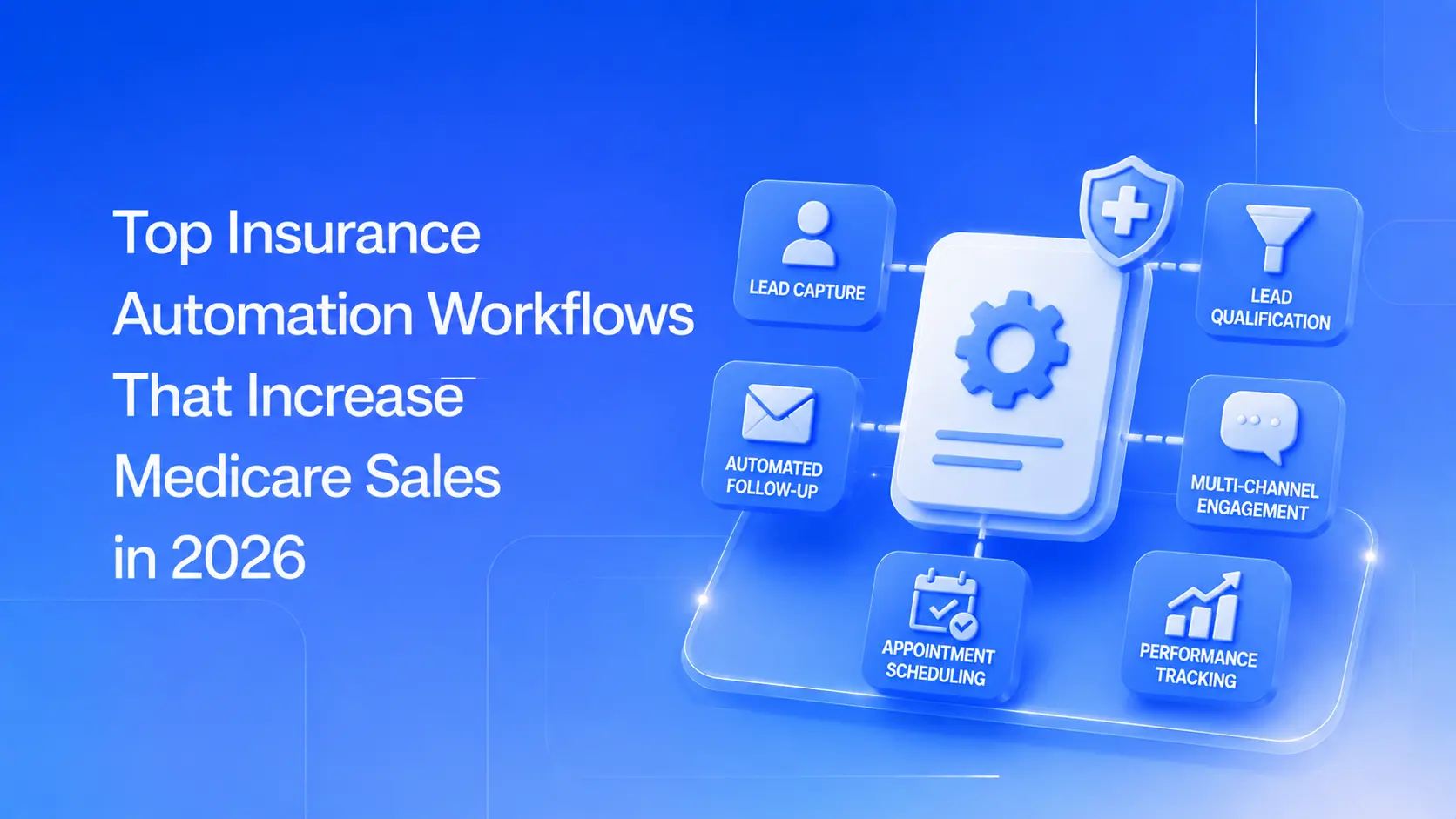
Phase one is lead capture automation: auto-routing inbound calls, capturing form submissions, and assigning leads to producers based on availability. This sits in front of your existing workflow rather than changing it. Phase two is CRM and follow-up automation. Phase three is policy and claims automation, where the real time savings compound. Phase four is full compliance and reporting automation.
Business Area | Manual Operations | Automated Operations (2026 Standard) |
Lead Management | Spreadsheets, sticky notes, phone logs | Auto-capture, scoring, nurture sequences |
Client Communication | Individual emails, no tracking | Templated workflows, open-rate tracking |
Medicare Enrollment | Paper forms, manual verification | Digital forms, e-signature, real-time eligibility |
Compliance Tracking | Manual logs, risk of missed deadlines | Automated audit trails, real-time CMS alerts |
Reporting and Analytics | Monthly spreadsheets, delayed insight | Live dashboards, predictive lead scoring |
Renewals Management | Calendar reminders, inconsistent | Automated 60, 30, and 7-day sequences |
Agent Productivity | 8+ hours/week on admin | Admin reduced to under 2 hours/week |
Reclaiming six or more hours per agent per week translates directly to more prospecting and more bound policies. Compliance tracking is the highest-risk row to leave manual, because a single missed CMS deadline can trigger penalties or plan disenrollment issues. Run the new workflow in parallel with the manual one for at least two weeks before cutting over.
Why Growing Insurance Firms Need an Automated Policy Administration System
Most agencies hit an inflection point somewhere between 50 and 100 active clients per agent, where manual policy administration starts breaking. Errors compound, renewals get missed, mid-term changes pile up, and clients start feeling the friction. An automated policy administration system handles issuance, mid-term changes, renewals, cancellations, and reinstatements without requiring a dedicated admin layer.
Medicare policy administration carries specific complications. Plan year changes happen on a fixed calendar. LIS and IRMAA adjustments need to be tracked accurately. SEP documentation has to be airtight. Industry benchmarks show automated policy administration reducing policy-related errors by up to 40 percent. Each error is a service call, a retention risk, or a compliance flag. For agencies growing a Medicare book, the automated administration layer is what allows production to scale without service quality dropping.
Have questions about automating your agency? Contact the Senior Center Agents team.
RPA Solutions vs. AI-Native Platforms: Which Automates Insurance Back-Office Tasks Better?
Robotic Process Automation is software that mimics how a human user clicks through screens, fills in forms, and moves data between systems. For insurance back-office work, RPA typically handles data entry across carrier portals, report generation, policy status updates, and compliance logging.
The limitation is context. RPA does not understand what it is doing. It follows a recorded script, so when CMS changes a form or a carrier updates a portal, the RPA bot breaks until someone re-records the workflow. AI-native platforms work differently. They learn from data, adapt when source systems change, and make decisions instead of just following scripts. The practical recommendation is to use RPA as supplemental automation for high-volume carriers and AI-native platforms as the primary stack for independent agents and agencies.
Expert Viewpoint: Why Insurance Process Automation Is the Highest-ROI Decision Medicare Agents Can Make in 2026
After watching dozens of agencies transition from manual to automated operations, the pattern is consistent. Agencies that automate their Medicare workflows in the first half of 2026 will hold a compounding advantage through AEP and beyond, because the gap between manual and automated operations widens every quarter.
The three insights that matter most are not about technology. First, automation reclaims time, and time is the only finite resource for an insurance agent. Agencies running fully automated workflows get back six or more hours per week per producer. Second, automation reduces error and compliance risk in a market where CMS enforcement is tightening. Third, automation scales without adding headcount, which is why agencies that automate early can grow without proportionally growing payroll.
Looking forward, the picture gets harder for non-automated agencies. CMS reporting requirements are expanding, Medicare Advantage competition is intensifying, and consumer expectations for digital experiences keep rising.
Start with Senior Center Agents.
Put Insurance Process Automation to Work for Medicare Sales With Senior Center Agents
Insurance process automation matters most when it removes the operational friction that slows Medicare agents down every day, from lead follow-up and enrollment handling to compliance tracking and renewal management. Senior Center Agents gives independent agents and agencies a Medicare-native platform that brings buyer-ready inbound calls, real-time routing, transparent pricing, and end-to-end workflows into one system.
For teams that want to spend less time buried in admin and more time moving prospects through the pipeline, that creates a faster, cleaner, and more practical path to stronger production.
Explore more insurance automation insights on the Senior Center Agents blog.
Frequently Asked Questions
What workflows should a Medicare insurance agency automate first?
Start with lead capture and CRM follow-up automation, since those are the highest-ROI entry points and carry the lowest implementation risk. From there, move to enrollment form handling, renewal reminders, and then claims and compliance last. Trying to automate complex underwriting or claims first usually causes rollout problems.
Is insurance process automation compliant with CMS regulations?
Yes, when you use a platform built with CMS compliance in mind. Compliant platforms like Senior Center Agents include audit trails, data handling aligned with CMS standards, and do not automate the regulated advisory conversations that require agent disclosure. Automation handles the logistics, while regulated parts of the Medicare sale remain in the agent's hands.
How long does it take to implement insurance automation software?
Implementation depends on the scope. Entry-level platforms like Senior Center Agents can be set up and active within 24 to 48 hours for individual agents. Full end-to-end automation with CRM migration usually takes two to four weeks for an agency. Phased rollouts reduce disruption, and most agents see measurable time savings in the first month.
Can a solo Medicare insurance agent benefit from automation tools?
Yes, and solo agents often benefit the most proportionally. Every hour reclaimed from admin converts directly to client-facing time. Automation replaces the need for a part-time assistant on tasks like follow-up emails, document collection, and renewal reminders. Senior Center Agents offers free and low-cost tiers built for independent agents.
What is the difference between RPA and AI in insurance automation?
RPA mimics manual steps by clicking through portals, copying data, and generating reports without understanding context. AI-powered automation learns from data, adapts when source systems or rules change, and makes decisions like lead scoring and risk flagging. For Medicare agents, AI-native platforms deliver more value than generic RPA tools.
How does insurance CRM automation increase Medicare sales?
Insurance CRM automation increases Medicare sales by making sure no lead goes uncontacted and no follow-up is missed. Automated CRMs trigger personalized outreach based on lead behavior, enrollment anniversary dates, and Medicare windows like AEP and OEP. Agents using automated CRM workflows report 30 to 50 percent higher contact rates compared to manual outreach.
What data security standards should insurance automation platforms meet?
Insurance automation platforms handling Medicare client data should meet HIPAA technical safeguards, use AES-256 encryption, offer role-based access controls, and maintain audit logs for CMS compliance. Always verify that a platform has a Business Associate Agreement available and a written policy against sharing or selling client data.
How does digital transformation in insurance affect Medicare agents specifically?
Digital transformation shifts Medicare client acquisition from phone-heavy cold outreach to data-driven, automated lead nurturing. Carriers now provide digital enrollment portals, CMS delivers ANOC and EOC documents electronically, and Medicare Advantage plan comparisons happen online. Agents without digital workflows lose prospects to automated competitors before the first conversation happens.