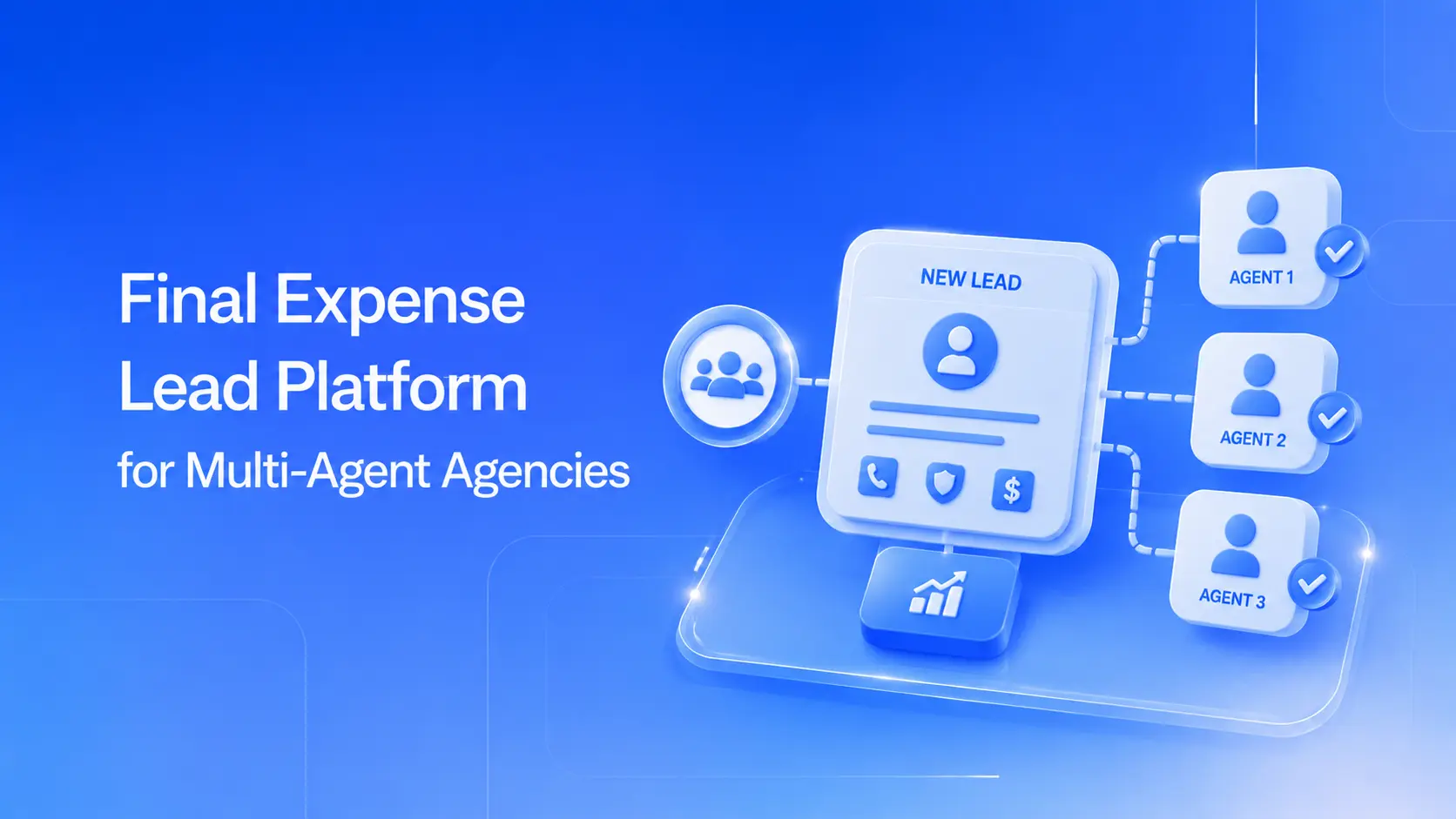
Agency owners, IMOs, FMOs, and call center operators all run into the same wall when they try to scale a final expense operation across multiple producers. The lead supply that worked for one or two agents stops working at five, ten, or fifty, while routing, attribution, and compliance overhead start eating into margin.
Final expense insurance agency leads sourced through a purpose-built agency lead platform solve that problem by creating more predictable lead flow across producers, routing logic that matches your team structure, and reporting that lets you actually see what’s happening at the producer level.
This is a platform built for agencies running 5 to 500+ producers, and the difference shows up in close rate, producer retention, and how quickly an agency can scale.
TLDR: A final expense agency lead platform delivers exclusive, shared, and live transfer leads to multi-agent operations with built-in routing, replacement, and reporting. Multi-state agency licensing is supported through state, county, and zip filtering with producer assignment logic built in. Pricing is transparent, CRM integration runs through API or webhook, and real-time routing turns lead supply into an operational system instead of a one-off lead purchase.
Key Takeaways
Final expense agency leads come in five primary tiers: exclusive internet, shared internet, live transfer, inbound calls, and aged inventory, each with its own cost and conversion profile.
Exclusive leads cost more but typically deliver a lower cost per acquired policy when producers convert consistently.
Multi-state agencies need geographic filtering at the zip, county, and state levels with producer license matching.
A lead platform built for agency-scale operations replaces the patchwork of separate vendor relationships.
TCPA one-to-one consent is now the compliance baseline, and weak consent infrastructure has wiped out a tier of older vendors.
Senior Center Agents is built for agencies running multi-producer final expense operations with real-time routing and transparent pricing.
Get agency-scale final expense leads through Senior Center Agents.
Buy Exclusive Final Expense Leads for Multi-State Agencies
Running an agency across multiple state jurisdictions adds compliance and routing complexity that most lead vendors are not built to handle. State insurance department rules vary, TCPA scrubbing has to be airtight, and producer licensing has to match the lead's state of origin before any contact happens. Exclusive final expense leads simplify the picture by removing the competition layer, since the lead is sold to one agency only and routed directly to one producer. That cuts down on dial races, reduces lead fatigue, and improves close rates because the prospect has not already been worked by three other agencies.
The difference between exclusive and shared sits at the heart of any agency lead strategy. Exclusive costs more per lead and pays back in close rate, producer morale, and a wider replacement window. Shared costs less and works for newer agencies still testing volume, but contact rates drop because the prospect is fielding calls from multiple agencies within the same hour.
Attribute | Exclusive Leads | Shared Leads |
Sold to | One agency only | 3 to 5 agencies |
Cost per lead range | Higher tier | Lower tier |
Average contact rate | Higher | Lower due to lead fatigue |
Close rate expectation | Stronger | Variable |
Best fit for | Established agencies with closers | Newer agencies testing volume |
Replacement policy | Typically wider window | Typically narrower |
Producer assignment | Direct routing to one agent | Race condition between agencies |
Geographic flexibility matters more for multi-state agencies than for solo producers. A good platform lets you filter at zip, county, or state level, which means you can match leads to licensed producers automatically. Compliance documentation, including TCPA one-to-one consent records and DNC scrubbing, should be attached to every lead at delivery.
Create your agency account to start receiving exclusive final expense leads routed to your producer team.
Best Lead Vendors for Growing Final Expense Agencies
Vendor selection is where most agency owners lose margin before they realize it. The market splits across data resellers, direct mail generators, digital marketers, call centers, and aggregators. The right vendor checks all of the following: lead source transparency, TCPA consent documentation meeting the one-to-one standard, a clearly written replacement policy, volume commitments with pacing flexibility, API or webhook integration, geographic and demographic filtering depth, transparent pricing, and reporting at the lead and producer level.
What separates a top tier final expense lead vendor from a commodity seller
Commodity sellers chase volume. They generate leads through any cheap source, sell the same lead to as many buyers as possible, and skip the compliance work. Top tier vendors invest in source quality, document consent properly, and treat their replacement policy as a core part of the product. Cost per acquired policy almost always favors the top tier once you factor in close rate and compliance risk.
Red flags when vetting final expense lead vendors
A few patterns reliably predict a bad vendor relationship: vague disclosure of where leads originate, no recorded consent files, replacement windows shorter than 24 hours, heavy resale of the same lead across many buyers, pressure tactics to sign annual contracts during evaluation, and "call for quote" pricing instead of published rates. Any one is a yellow flag. Two or more is a hard pass.
Questions every agency owner should ask before signing a lead contract
Ask about the lead source URL for a sample lead. Ask for a sample of recorded TCPA consent. Ask how the replacement policy is administered and what percentage of leads typically get replaced. Ask whether you can pause volume during a slow week or scale up for AEP. Ask for references from agencies of similar size.
Final Expense Insurance Agency Leads for Recruiting Agents
Lead supply is not just a sales input. For an agency owner, it is one of the strongest recruiting tools available. New producers want to know they will have a steady pipeline from day one, and existing producers stay longer when the lead flow is consistent. Predictable supply separates an agency that recruits and retains from one that constantly churns through new hires.
The mechanics are straightforward. New hires get paired with a starter lead package sized to their licensing footprint and skill level. Lead cost pass-through models, where the producer reimburses lead spend through commission deductions, work for some agencies, while others run a fully agency-funded model in exchange for higher splits. Reporting that shows producer income potential with real data gives recruiters a story they can back up with numbers.
Lead-cost reimbursement also improves 90-day retention because new producers can see their unit economics clearly. When a producer can track exactly what they paid for leads, how many they closed, and what they earned, the path forward becomes obvious.
Agent signup is the fastest way to bring new producers into a platform with predictable lead supply already built in.
How to Generate Agency-Level Final Expense Opportunities
There is a build versus buy decision every agency eventually has to make, and the right answer is usually a hybrid model. Buying leads gives you instant volume and predictable pacing. Generating leads in-house gives you better margin and more control over source quality. Most agencies that scale past a certain size run both at once.
Channel | Lead Intent | Cost Profile | Speed to Volume | Compliance Burden | Best Suited For |
Facebook direct response | Medium | Moderate | Fast | High due to TCPA | Agencies with marketing ops |
Direct mail with BRC | High | High per lead | Slow | Low | Senior-focused producers |
Inbound calls (pay per call) | Very high | High per call | Fast | Moderate | Closers and call centers |
Live transfers | Very high | Highest | Fast | Moderate to high | Veteran producers |
SEO and organic | Variable | Low long-term | Very slow | Low | Brand-building agencies |
Lead aggregators | Variable | Low to moderate | Instant | Vendor-dependent | Agencies testing markets |
The build side requires marketing operations capacity, which not every agency has. The buy side fills the gap immediately. A platform that combines purchased leads with self-generated leads in one dashboard removes the operational tax of running multiple systems.
Scaling a Final Expense Agency Using Purchased Inbound Leads
Unit economics drive every scaling decision. The numbers that matter are cost per lead, contact rate, set rate, close rate, average premium, and producer lifetime value. Get those right and scaling becomes math.
Final expense lead unit economics every agency owner should know
A workable starting framework: a $25 shared internet lead at a 60 percent contact rate, 25 percent set rate, and 12 percent close rate yields one closed policy for roughly every 56 leads, which is a cost per acquisition near $1,400. A $75 live transfer at a 95 percent contact rate, 70 percent qualified rate, and 22 percent close rate yields one closed policy for roughly every 6.5 transfers, near $490 CPA. Higher cost per lead with better close mechanics often produces lower cost per acquired policy.
How to scale producer headcount alongside lead volume
Producer headcount and lead volume have to scale in lockstep. Adding leads faster than producers means leads age out before they get worked. Adding producers faster than leads creates morale problems. A reasonable ratio for final expense is one full-time producer per 60 to 100 leads per week.
When to graduate from shared leads to exclusive and live transfers
Most agencies start with shared internet leads because the entry cost is lowest. The moment to graduate is when your producers are converting well, CRM disposition discipline is in place, and unit economics show that higher cost per lead would still produce lower cost per acquired policy.
Final Expense Agency Marketing System for Consistent Lead Flow
A marketing system at the agency level is not the same as buying leads. Buying leads is one input. A marketing system is the entire architecture of how leads get acquired, routed, worked, tracked, and reported on across every producer. The components include a lead acquisition layer combining purchased vendors and owned channels, real-time distribution and routing rules, producer assignment logic, speed-to-lead automation under 60 seconds, drip and nurture sequences for unworked leads, compliance documentation storage, and reporting with producer scorecards.
When all components run through one platform, operational overhead drops dramatically and visibility improves at every level. When they are scattered across separate tools, the gaps between systems become the gaps in your production.
Talk to our agency team if you want to map your current lead system to a more unified setup.
Pay Per Call Campaigns Feeding Final Expense Agency Call Centers
Pay per call is a final expense lead model where the buyer pays only when a qualifying caller stays on the line past a defined duration. The call originates from a marketing channel, hits an IVR or call buffer for qualification, and then transfers to an agent if it meets the agreed criteria. Pay per call works well for call centers because it aligns cost with consumed inventory and reduces wasted dial time on low-intent leads.
Billing typically triggers at a duration threshold of 60, 90, or 120 seconds. Qualification criteria usually include age band, state of residence, and confirmed intent to discuss coverage. Calls that disconnect early or fall outside qualification criteria are usually non-billable and disputable.
Operationally, accepting pay per call requires real readiness. You need adequate licensed agent staffing during the buyer's hours, concurrency caps that match call volume, and routing logic that splits closers from setters when needed.
Co-op Marketing Programs Providing Final Expense Agency Leads
Co-op marketing in the IMO and FMO context refers to programs where a carrier, upline, or distribution partner subsidizes part of your lead cost in exchange for production commitments. The trade-off is straightforward: the agency gets lower effective lead cost, and the carrier or upline gets contracted volume and often partial exclusivity on the business produced.
Eligibility usually depends on hitting production thresholds in a previous quarter or year. Contract lengths range from quarterly to annual. Exclusivity clauses sometimes restrict which carriers the agency can submit through, which is a meaningful trade for some agencies and a deal-breaker for others.
Funding Model | Who Pays | Production Required | Lead Ownership | Best For |
Self-funded leads | Agency | None | Agency | Independent agencies |
Co-op subsidized | Carrier or upline | Yes, tiered | Often shared | Growing agencies in IMO |
Lead reimbursement | Upline on issued business | Yes, per policy | Producer or agency | Recruiters |
Pass-through to producer | Producer via commission | None | Producer | Captive-style models |
Hybrid program | Split between agency and producer | Variable | Variable | Multi-tier agencies |
Co-op programs work best for agencies that already have production momentum. They work poorly for agencies that have not yet hit consistent production, because threshold requirements turn into pressure rather than support.
How to Assign Final Expense Leads Across Agency Producers
Assignment logic determines whether your producer team feels like a meritocracy or a lottery. Round robin distributes equally and is simple to administer, but it can reward underperformers with the same volume as top closers. Performance-based routing raises the overall close rate but demoralizes mid-tier producers who watch leads flow to the top of the board. Each method has trade-offs.
Round robin distributes leads equally across producers and is simple to administer, but it can reward underperformers and dilute lead value.
Performance-based routing sends more leads to top producers, raises the overall close rate, and risks demoralizing mid-tier producers if not balanced.
Geographic routing matches producers to state or zip code, supporting licensing requirements but creating coverage gaps in lighter markets.
Schedule-based routing sends leads to producers actively on shift, which fits call centers with set hours.
First to claim routing pops leads into a queue and rewards the fastest producer, which creates urgency but can favor producers willing to grab everything regardless of fit.
Tiered routing combines performance and seniority for a hybrid model that protects new producers while still rewarding top closers.
Most agencies blend two or three of these methods. A common pattern is geographic routing as the first filter, performance-based weighting as the second, and a round-robin layer as a tiebreaker.
Agency CRM Setup for Managing Final Expense Lead Pipelines
Generic CRMs underperform for final expense agencies because they are not built around insurance-specific dispositions, multi-state licensing, or compliance recording. A final expense agency CRM has to handle the moving parts that a generic CRM treats as edge cases. The features that matter include lead source attribution at the individual lead level, producer assignment and reassignment workflows, disposition libraries built for final expense (set, sold, no answer, callback, DNC), compliance recording integration, carrier and product attachment per opportunity, commission and policy status sync, multi-state license routing, and reporting on speed-to-lead, contact rate, set rate, and close rate at the producer level.
Data hygiene is the other half. Duplicate-handling rules, lead-aging policies, and disposition discipline are what keep a CRM from turning into a dumping ground. Agencies that run regular hygiene cycles and enforce disposition discipline achieve cleaner data and better decision-making from the same system.
People Also Ask: Final Expense Agency Leads
Where can agencies buy final expense leads?
Agencies can buy final expense leads from specialized agency lead platforms, direct mail vendors, call centers selling live transfers and pay per call, and digital marketing agencies running Facebook or Google campaigns. The right source depends on your producer model, budget, and how much you value exclusivity, speed, and compliance documentation.
What are the best final expense leads for insurance agencies?
The best final expense leads for agencies are exclusive, real-time, TCPA-compliant, and routed through a system that supports your producer assignment rules. Exclusive internet leads and live transfers typically deliver the strongest close rates. Shared and aged leads work for high-volume dial operations.
How much do final expense insurance leads cost for agencies?
Final expense agency lead costs in 2026 typically range from $8 to $18 for shared internet, $20 to $40 for semi-exclusive, $45 to $90 for exclusive real-time, and $55 to $120 for live transfers. Aged leads run $2 to $8 each. Volume tier, geographic targeting, and demographic filtering all move pricing.
What is the difference between shared and exclusive final expense leads?
Shared leads are sold to 3 to 5 agencies, which means the prospect fields multiple calls in a short window, and contact rates drop. Exclusive leads are sold to one agency only, which raises close rates and producer morale but increases cost per lead. Exclusive typically delivers a lower cost per acquired policy when producers convert consistently.
Read our agency growth resources for deeper analysis on lead types, routing, and producer economics.
Expert Viewpoint: Building a Durable Final Expense Agency Lead Engine
After years of watching agencies scale and stall, the pattern is clear. A lead platform built for agencies is operationally different from a lead vendor that happens to sell to agencies. The difference is in routing, replacement, reporting, and integration, and it shows up in producer retention and net margin within the first quarter.
The five recommendations that matter most for agency owners building a durable lead engine:
Set your unit economics before scaling spend, because higher lead volume amplifies whatever close rate you currently have.
Match lead type to producer skill level, since exclusive leads and live transfers reward strong closers and punish weak ones.
Measure speed to lead at the producer level, not the agency level.
Treat compliance documentation as a revenue protection asset, since TCPA enforcement is tightening.
Build a lead mix portfolio rather than depending on one channel.
The agencies that win in 2026 are the ones that stop treating lead supply as a transactional purchase and start treating it as a managed system.
Create your agency account to start running a unified lead system across your producer team.
Scale Final Expense Insurance Agency Leads Through Senior Center Agents
Final expense insurance agency leads work better when they’re delivered through a platform built for multi-producer operations, not stitched together across disconnected vendors, spreadsheets, and manual routing rules. Senior Center Agents helps agencies create more predictable lead flow, assign leads by geography and producer structure, track results at the producer level, and keep compliance tied to the delivery process. That gives growing agencies a cleaner way to scale volume without losing visibility, speed, or margin.
Explore how Senior Center Agents supports multi-producer final expense operations with real-time routing, transparent pricing, and agency-level reporting. Get started with a setup built to help your team handle final expense insurance agency leads more efficiently and scale with fewer operational gaps.
Explore how Senior Center Agents helps multi-agent teams manage final expense insurance agency leads with real-time routing, transparent pricing, and producer-level reporting.
Frequently Asked Questions
What are final expense insurance agency leads?
Final expense insurance agency leads are verified senior prospects, typically aged 50 to 85, who have expressed interest in burial or final expense coverage and are delivered to an agency for distribution across multiple producers. Agency-level leads differ from individual agent leads in volume, routing logic, and reporting depth.
How do agencies generate final expense insurance leads?
Agencies generate final expense leads through four primary methods: paid digital advertising on Facebook and Google, direct mail with business reply cards, inbound call campaigns including pay per call, and organic content through SEO. Most multi-agent agencies run a blended model.
Are exclusive final expense leads worth it for agencies?
Exclusive final expense leads are worth it for agencies with closers capable of converting at a rate that justifies the higher cost per lead. They typically deliver stronger close rates, better producer morale, and a wider replacement window. For newer agencies still building close rate consistency, shared leads usually pencil out better.
How can insurance agencies improve final expense lead conversion?
Agencies improve conversion by hitting speed to lead under 60 seconds, enforcing producer scripting discipline, running multi-touch follow-up sequences, vetting lead source quality regularly, and maintaining strict CRM disposition standards.
Which companies offer the best final expense agency leads?
The best final expense agency lead providers offer transparent sourcing, TCPA one-to-one consent documentation, agency-grade routing logic, a clearly written replacement policy, and reporting that goes down to the producer level.
How do live transfer final expense leads work for agencies?
Live transfer final expense leads work by routing a pre-screened prospect from a qualifying call center directly to an available producer. The call center confirms age, intent, and basic qualifications, then transfers the live caller. Billing typically triggers at a defined call duration threshold.
What is the typical close rate on final expense agency leads?
Close rates vary by lead type. Shared internet leads typically close at 4 to 9 percent. Exclusive internet at 8 to 15 percent. Direct mail at 10 to 18 percent. Live transfers at 18 to 30 percent.
How quickly should agencies contact a new final expense lead?
Final expense leads should be contacted within 60 seconds for internet and form-fill leads, and immediately for live transfers. Contact rates drop sharply after the first 5 minutes. Speed to lead is the single most consistent predictor of close rate.